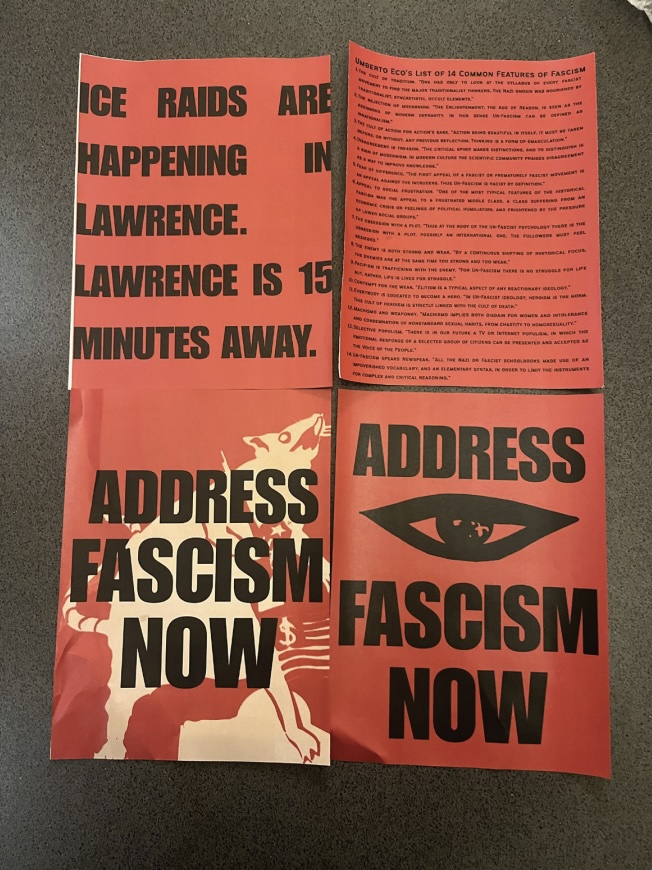
Flyers with information on facism were placed on Paresky Commons tables on November 7
Following the cancellation of a student-led protest in October, former student Yara Handschin ’27 reached out to hundreds of community members on November 7.
In her message, Handschin shared a document titled “A Guide to Protest at Andover,” with her own instructions for organizing demonstrations at Andover. She urged students to further engage in civil and political discussion in relation to the principles it upholds in the Blue Book.
“I want to encourage the student body of Andover to hold their school administration accountable to uphold the values it claims to possess. Making use of this institutions’ uniquely protected social positioning to exercise your right to free speech and social critique is incredibly important at a time where many people around the US are losing their ability to do so,” wrote Handschin.
Shloak Shah ’26 shared that there is a desire from students on campus for framed education, even if it isn’t always vocalized. He referred to an event, facilitated by instructors in the Department of History and Social Science, that garnered student attendance last February, titled “Breaking Down Today’s America.”
“There’s a lot of passive demand on this campus for not only more conversations about politics, but more informative conversations about politics. Last winter, there was this event where four or five History Department faculty and a couple dozen students [attended]. It was just a way for students to clear up some misconceptions they had about U.S. civics and U.S. politics,” said Shah.
Alfonso Gonzalez-Cano ’27 hoped that Handschin’s guide would be a step forward in discussing the administration’s policies towards current events.
“I hope this sparks conversation in terms of the protest and on how the faculty [and] administration handle it. But then again, I’m unsure as to whether it will, because oftentimes, it’s easy for important things to get swept up in the busy end of life,” said Gonzalez-Cano.
During All-School Meeting (ASM) on November 10, Susan Esty, Dean of Students and Residential Life, encouraged students to properly follow the school guidelines for staging a protest in the Blue Book (pages 31-32). The Civil Discourse and Political Activity policies outline the procedure for organizing a demonstration on campus. In addition to being “required to comply with any requests or restrictions from the Academy or public officials, including but not limited to the instruction to disassemble, remove positives, or relocate off campus,” students must also “speak with their cluster dean prior to planning or engaging in any form of Demonstration.”
Head of School Raynard Kington explained how student leaders have been trained to lead conversations on civil discourse and current events this year and in the past.
“We have had training. We get training for faculty about how to have these difficult conversations. We did training for student leaders as well. That was part of this effort of if we train enough people, then a lot of the most meaningful conversations aren’t in a lecture hall, in Kemper [Auditorium], or an All-School Meeting. They’re in the dorm common room or in a living room,” said Kington.
While Shah, a proctor in Stuart House, acknowledged that student leaders received training about facilitating general communication amongst peers, he noted that such training did not specifically focus on conversations around current events.
“There are a lot of broader ideas or settings we’re trained in about connecting with the students under our management, but none of it has been explicitly political. If you’re going to make that kind of statement, you’re suggesting that you’re preparing students for the sorts of more consequential and more nebulous discussions, and that’s just not accurate,” said Shah.
Toni Elliott ’27 emphasized that political discourse, though it can feel difficult, is crucial to fostering change. She explained that students often find it hard to discern what they are unaware of in the first place, making such conversations even more important.
“The conversations that are the hardest to have are the ones that we need to be having. Even if it’s not an intentional avoidance of those topics, it still matters. The fact that we don’t even realize that we’re avoiding them speaks more to the fact that it’s just not something that’s talked about [on campus],” said Elliott.
Elliott suggested ways that administrators could improve student awareness of current events on campus. She described how political discourse can start with changes in campus culture that promote school-wide discussions.
“[Campus discourse] would have to come from more cultural changes, whether that’s by having ASM speakers that are speaking on topics that would provoke more discussion, acknowledging events that are happening in school-wide emails, or having a political news email that goes out once a week just to spark conversation… Just doing things that aren’t explicitly geared towards forcing those conversations, but [encouraging] them, is definitely something that the administration could do,” said Elliott.
Maya Tomlinson ’28 echoed Elliott’s sentiments, expressing that she wished that the administration hosted more measures geared toward facilitating political debate. Tomlinson proposed a few school-wide initiatives that could address this issue.
“I don’t recall the administration or Andover as a school doing anything to foster political debate. The only place I’ve seen political discourse is [the] Current Events Club, and that is student-run and not directly supported by Andover’s administration. During protected time or department meetings, [the administration] could set up spaces for people to discuss what they think. Hopefully, that would have larger attendance because it’s coming from the school and not from a student-run club. It doesn’t even have to be inherently political. It could just be discussing the current events in the world,” said Tomlinson.
The school has offered framed educational programming on current political events, including a multi-part Presidential Speaker Series in 2024 and an event introducing the history of the Israel-Palestine conflict in December 2023.
Kington reflected on the Israel-Palestine event, which featured Frank Tipton, educator in Middle Eastern studies and former Andover Instructor in History. At the time, Senior administrators communicated that Tipton’s presentation would be the first of several more covering the conflict. Kington shared why this was ultimately not the case. He also conveyed a willingness to implement more regular educational opportunities for students on current events.
“With the issue in the conflict in the Middle East, we tried to find other people, [but] it’s not easy to get people to speak on these topics. I’m open to thinking about how we can do this more regularly and to decide upon a structure. We’ve been trying to think of other ways to do it. Certainly, some student clubs have played and continue to play a big role in having events, but we’re open to suggestions. I actually think we probably should be doing more,” said Kington.