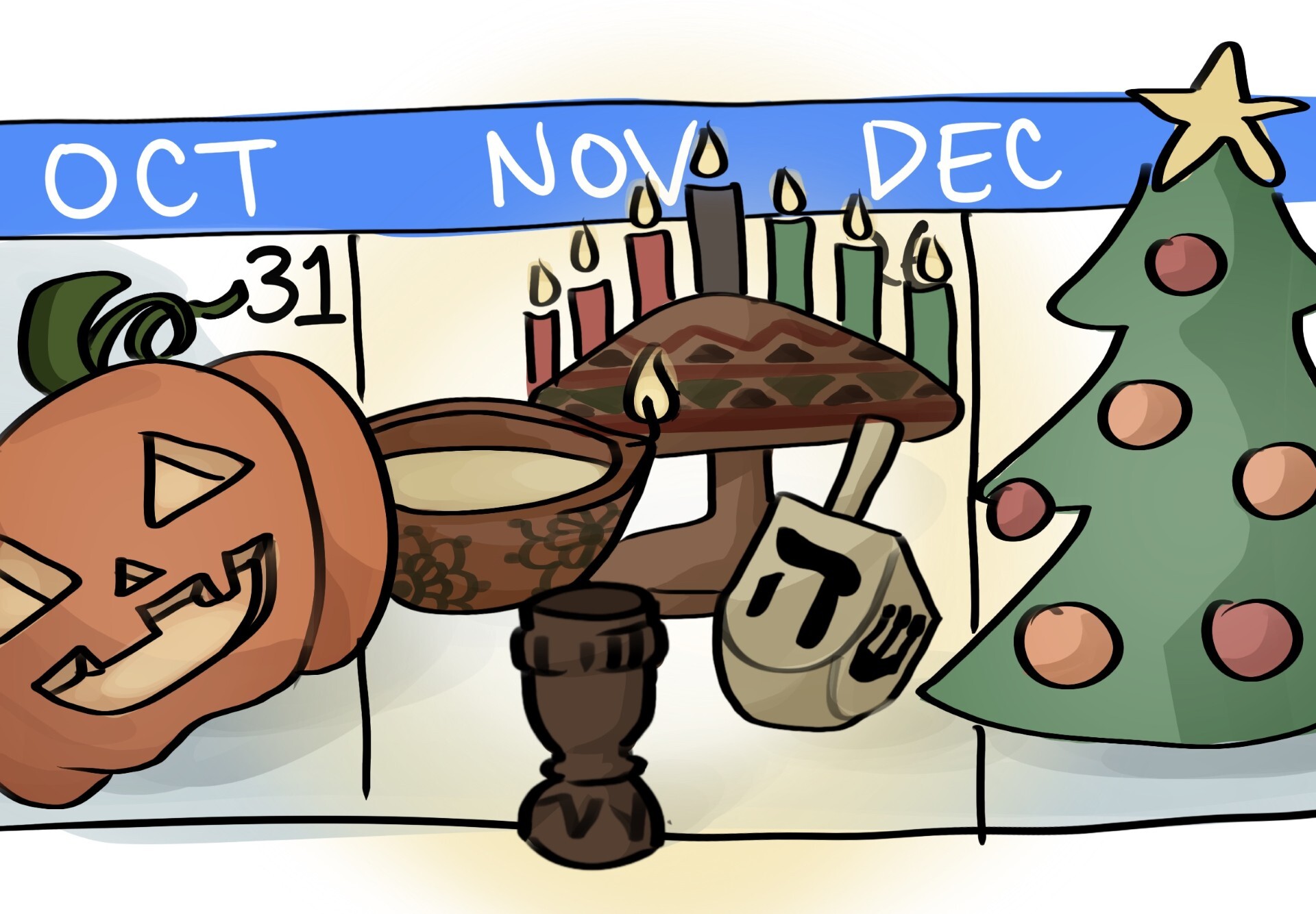
November 1st is the day right after Halloween. Even if it is not a particularly special day, there are some obvious changes. You see Halloween items on clearance in shops, and most importantly, it feels like winter has already started. Christmas decorations flood the shelves. In Andover’s own CVS, this proves true. Even though there are countless other holidays that happen before or around the same time as Christmas, it’s as if they aren’t at all relevant. In a place where there are many people of different cultures, there should be more variation in decor they sell for holidays. Businesses move on from Halloween quickly, skipping over other important holidays like Hanukkah, Kwanzaa, and Diwali, just to sell for Christmas, which is dismissive and uninclusive of not only multiple other holidays, but religions and cultures.
Many holidays fall between Halloween and Christmas; one of which I celebrate is Diwali. While sometimes it falls before Halloween, this year the most celebrated part fell on Sunday, November 8th. See, Diwali is a five-day celebration, which spanned from the 6th to the 10th of November this year. In Hinduism, this is known as the Festival of Light and is one of the most celebrated holidays in my culture. When trying to celebrate, I decided to look for some diyas, which are small lamps. Though I am unable to light them in the dorm, they can be painted traditionally. I planned to purchase some and utilize my paints, then keep them as a decoration of my heritage. Yet, there is nothing in any stores nearby to purchase in celebration of Diwali. Diwali is not the only Holiday that suffers from this fate.
For religious holidays besides Christianity, they are pushed aside. Near Christmas, there are other holidays celebrated frequently in the USA, like Hanukkah. Hanukkah is a Jewish holiday, representing a miracle in which only one day’s worth of oil lasted for eight days, symbolizing the nine slots on the menorah. The oil was to allow the Maccabees, Jewish revolutionaries, to have light after a successful revolt. It’s also called the Festival of Light in its respective culture. The one in the center is used to light the others. Hanukkah is well-known in the USA and taught often in many school curricula, but it is still neglected in many storefronts. This year, it starts on December 4th and concludes on December 12th. In the USA, 5% of the population celebrates Hanukkah, which is at least 5 million people. The sheer number is represented in at least some way in convenience stores. If it is appropriate to sell small Christmas trees in these stores, then menorahs and candles should also be sold.
Not only religious holidays but also cultural holidays are dismissed, such as Kwanzaa, which happens around the same time as Christmas. Kwanzaa is a Pan-African holiday, spanning from December 26th to January 1st. The main purpose of the holiday is to celebrate seven principles over the seven days. Kwanzaa is celebrated by 3% of the USA population, and there are multiple decorations and physical symbols of the holiday, such as the Kinara. A Kinara is a seven-slotted candle holder, where there is one candle placed for every day of the holiday that goes by. Another important part of Kwanzaa is the candles placed in the holder, called Mishumaa Saba. To skip over 3% of the population is to skip over at least 3 million people, all of whom deserve decorations to celebrate their culture. Another known cultural holiday is Día de los Muertos, which happens directly after Halloween, from November 1st to 2nd. Día de los Muertos, or Day of the Dead, is primarily celebrated in Latin American cultures to remember deceased loved ones with altars. Altars typically have salt, sugar skulls, and a special bread called pan de muerto. 28% of the US population is also known to celebrate Día de los Muertos, so excluding the holiday would be excluding over 75 million people.
Next time you go shopping, take note of how most stores sell only certain decorations, and consider your own culture. Do you see it on those shelves? It’s great if you do, but remember that a lot of others won’t. Keep in mind that all cultures and religions are important, so they should all be represented in a storefront, not just the most common ones.