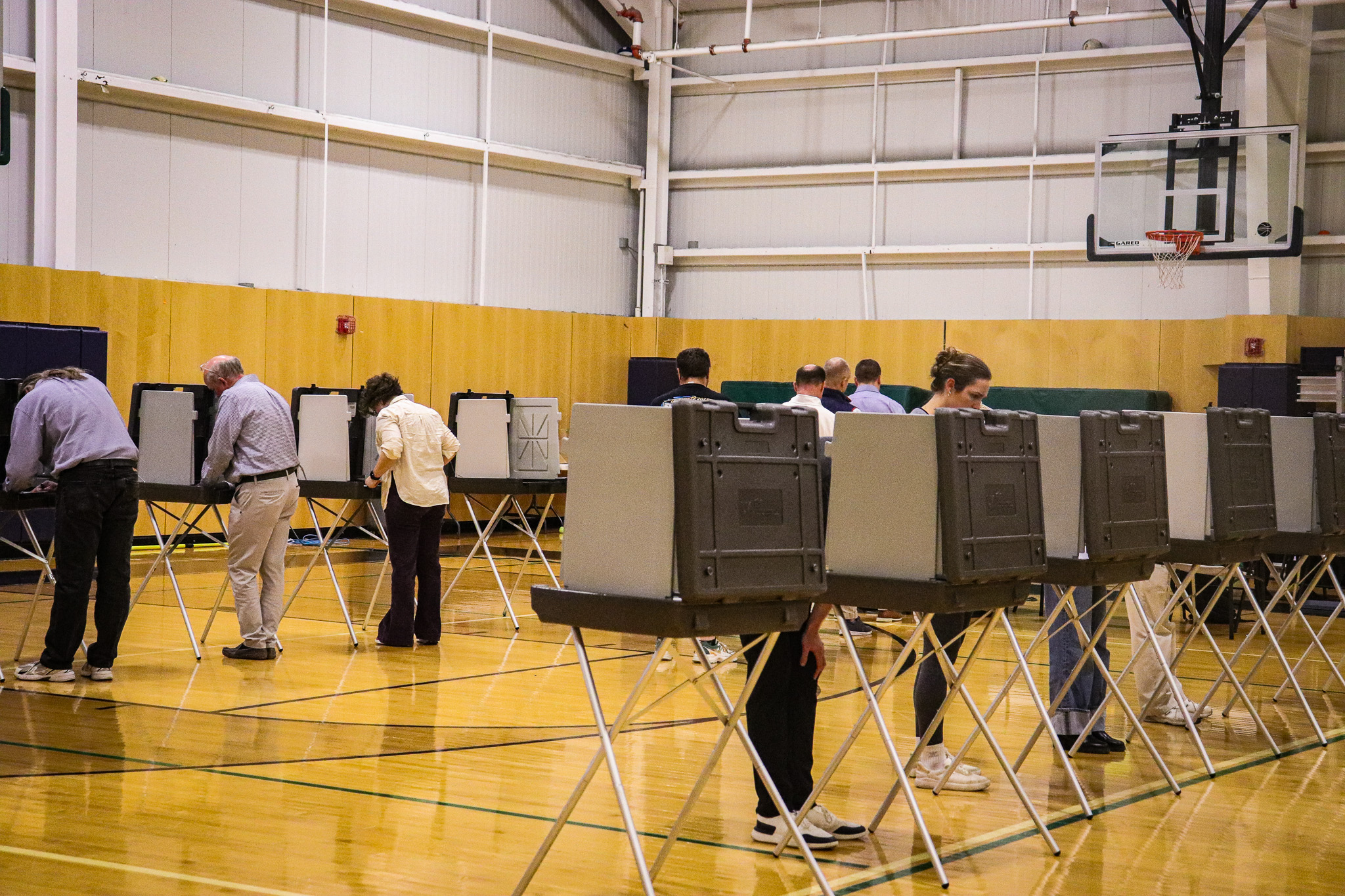
Andover residents in precincts 1 and 3 voted at the Youth Center on Whit-
tier Court on Election Day.
In Tuesday’s United States midterm elections, voters cast ballots for 435 House seats, 35 Senate seats, and 36 governorships. Democrats won races in several Republican strongholds. At Andover, students and faculty discussed the elections both in and out of the classroom.
The Andover Political Union (APU) and Current Events Club hosted a watch party for the midterm elections in the Freeman Room of the Oliver Wendell Holmes Library (OWHL). Kayden Robinson ’29, a board member of APU, discussed the event’s goals.
“I’m hoping that students are able to better understand our political system now [and] just know how elections work more thoroughly and know how people can get out to vote. And, I hope that people see the shifting climate of the political landscape [in] the United States now,” said Robinson
Gabbie Kawooya ’27, who attended the watch party, reflected on seeing her home state of South Carolina elect Annie Andrews, the first Democrat to win a U.S. Senate race there since 1998.
“My whole life, I’ve pretty much lived there, and it’s been a very, very conservative red state. And so it was very interesting to see how new voters, like a lot of my friends and people who would have been my classmates back home, got to vote for the first time. Seeing their influence on what happened, but also the switch in perspective in a lot of people in older generations who’ve historically voted red [was] a really big moment, for sure,” said Kawooya.
Andrew Park ’28, who lives in Texas, expressed surprise regarding Democratic victories in the state.
“The polls showing a Senate flip, that was very interesting. And seeing that happen in a very wide margin was also very interesting. More so was actually the governor’s seat flipping from [Gregory] Abbott. Governor Abbott, who was there for a really long time, was flipped to [Gina Hinojosa]. I was not expecting that because Abbott historically does very well with more moderate voters. But that changed this time,” said Park.
Some instructors incorporated the midterm elections into their classes. In her History 300 sections on Monday, Natalya Baldyga, Instructor in History and Social Science, taught a lesson on the midterms and the Massachusetts ballot questions. She then held a class discussion on Wednesday on the election results. Baldyga explained why she covered the elections and how she decided what to focus on.
“Most of us in the History Department see our job as teaching not only history, but also civics. Part of learning U.S. history is becoming an informed citizen so that you are actually taking charge of this government because, of course, as a republic, we are meant to have a say in our own governance,” said Baldyga.
Baldyga continued, “I wanted folks to have a sense of the national picture and what midterms were, but also major races that we were tracking and also the changes that had happened in advertising and campaign spending that had particularly impacted this election. So that was kind of the macro. I wanted them to think about what was happening right here on the ground in Massachusetts and look at the issues that the citizens of this state were wrestling with. So I wanted to have a macro and micro moment.”
Sarah Driscoll, Assistant Chair and Instructor in English, covered different aspects of the midterm elections in her courses. Her English 300 sections examined the Massachusetts ballot questions and battleground states, and in English 498, American Studies for International Students, she focused on voting trends among Indigenous voters. In English 541BL, “Crossing the Line”: U.S.-Mexico Border Literature and Contemporary Politics, Driscoll focused on Texas and its borderland regions. Driscoll discussed the importance of students staying informed about politics.
“The end goal is to ensure that our students do get into politics and think that they could make an impact, not just in terms of voting, but in terms of actually pursuing, perhaps, professions in the political world in the future,” said Driscoll. “I always do classes on civics when there are elections. I’ve never ignored what’s going on around the world… I want to encourage my students to be involved in politics and to not become cynical or resigned, but rather to really be as activists as they can in their lives.”
Gabby Gillette ’28 voted for the first time in her home state, New Hampshire. She highlighted the importance of voting.
“As we were talking about [in Driscoll’s English 300 class], there are so many close elections and New Hampshire is a swing state, so I thought I needed to do my civic duty and vote,” said Gillette.
Anish Kumar ’28, a student in Driscoll’s English 300 class, appreciated discussing the elections in a classroom environment.
“In class, especially with something as important and relevant as the midterm elections, I was pretty freely able to discuss all my opinions on these matters without facing judgment from my peers, because [Driscoll] was facilitating it and would, if it were to happen, where I’d face judgment for that, she would definitely step in, and she’d stop that judgment from happening. And it was cool to see how different students and myself differ in our political opinions,” said Kumar.
Matt Hession, Instructor in History, held a discussion in his elective History 573, House Divided: Political Polarization, Nixon to Obama. Kawooya described the conversation she had in Hession’s elective and elaborated on how it related to the course’s themes.
“[Hession] started the class by asking us what questions we had or what observations we shared about what happened last night with a lot of seats flipping, and then we talked a little bit about what happened with Texas and Kansas, and then what’s still happening with Mississippi and other swing states, in Alaska,” said Kawooya.
She continued, “We’ve been studying the history of elections and trends with polarization since 1963, and so we just finished up with studying the Obama election. It tied right into the timing of it too, with studying an election happening right now… It makes you more aware of things that have happened in the past and strategies people have used and just the history of how we got to be so polarized as a country. And so in learning that, you get to see the trends and patterns that are repeating today.”
Michelle Onyeka ’27, a board member of Current Events Club, did not have any discussions on midterm elections in her classes, which she attributed to a lack of relevance. She reflected on general student discourse about the elections.
“All my classes right now don’t really look at politics. And so neither of my teachers ever talk about current events, which is a little bit unfortunate… Some history classes, like History 300, cover [elections]. And I know my friend is in ‘House Divided’ for her history elective. And [in] environments like that, it’s easy to bring up the midterms, but that’s pretty much it. It’s dependent on the students to come up with spaces to talk about the midterms,” said Onyeka.
She continued, “I know a lot of my friends are very politically informed, and we spend a lot of our time talking about the midterms and the current political climate. I know that a lot of my friends stayed up pretty late, just watching a lot of the States turn blue and celebrating. And we go to a pretty liberal school. So you’ll find that most people are Democrats, but either way, whatever sort of party you are, that everyone still finds spaces to talk about it with their friends.”
Park said that politics rarely came up in casual conversation with friends at Andover.
“I think that if you take out social media, it would be very hard for me to remember situations where I talked about politics casually with my friends or even in a place where politics was not part of homework, where we willingly talked about politics,” said Park. “I think that Andover is not the most political environment.”
Robinson discussed the implications of the midterm results and encouraged the Andover community to pay heed to national politics.
“These coming two years will be very interesting to watch because obviously now we have a very Republican executive branch and a very Democratic legislative branch. So that if more people will stay updated on how that plays out, this could be a very important two years for not only the coming years, but for decades in the future. So people should really pay attention to what’s going on, especially right now,” said Robinson.
Editor’s Note: Felix Bret is a Co-President of Andover Political Union and a News Editor for The Phillipian. Bret was not involved in the reporting of this article.