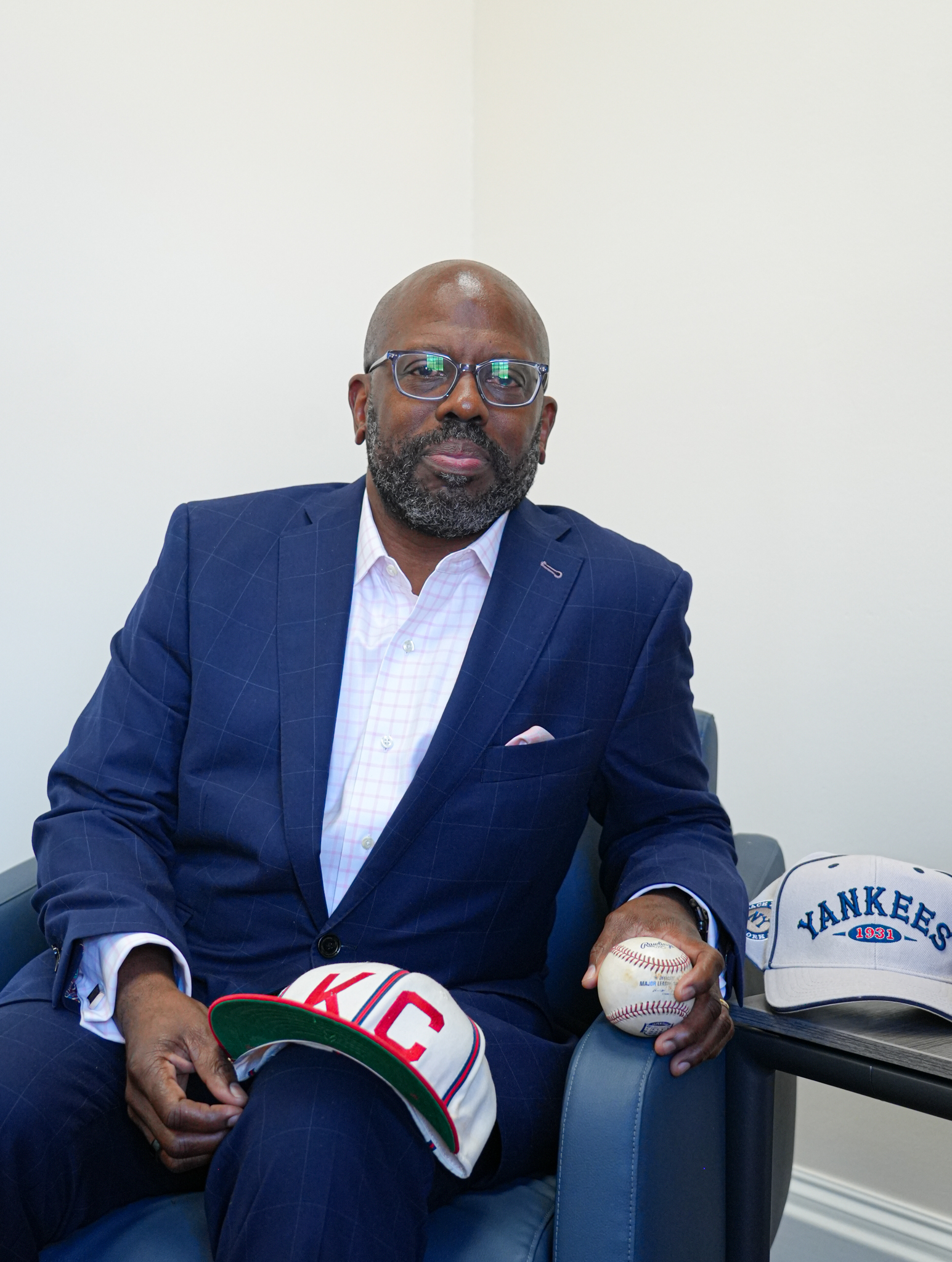
Christopher Seeley (he/him) is the Interim Assistant Dean of Students for Residential Life. Before coming to Andover, he worked at institutions including Groton School, Saint Thomas Choir School, Church Farm School, and Cambridge School of Weston. Seeley attended boarding school himself and has now spent 33 years working as an educator. In his free time, he enjoys cooking, watching and playing sports, and listening to jazz music.
You’ve worked in education for much of your career, but your undergraduate degree was in Religion and Spanish. What originally made you interested in education? What has kept you in the field for so long?
There are a number of educators in my family, and my wife’s as well. It’s a little bit of the family business. Before that, I can attribute my wanting to teach to the time that I spent in boarding school. I was able to establish really close connections to faculty, and there are some really close connections that I maintain with some of the people who taught me. I was inspired by the work that they do. I had a great experience when I went off to school, and I thought, if there was a way to offer the same experience to other students, to do a lot of the things that I enjoy, not just teaching, but also living in dorms and coaching, that would be a great thing. I started in education right out of college, and 33 years later, here I am.
Prior to coming to Andover, you worked at many different schools with different backgrounds. What have these different communities taught you about education?
The fundamental truth of education is that it’s all about relationships and building close relationships where people are free to be who they are. They can bring their full selves to the experience, and they can offer their perspectives and learn from one another. Those are the things that underscore the strength of a vibrant learning community, which is to say, everyone’s a learner. Teachers continue to learn and to grow, while students are clearly there to learn and to grow. They come together, both individually and collectively. That’s really the strength of what schools are about. I’ve been at small schools for the most part. [In smaller schools] the strength of community, as the foundation of the experience, has been easier. But even in a place that’s large like Andover, community remains important. It may not be possible for everyone to know everyone else. People build communities within the school.
You’ve worked in schools with different sizes, structures. What’s something you’ve learned about students that you think is true regardless of whatever school that you’re at?
Finding ways to engage students in their learning and to help them understand that they are in charge of their experience is really important. School isn’t about what people do to you. It’s about what you do for yourself and with other people. One of the things that I’ve really tried to focus on is enhancing the adult understanding of how we can help students understand their agency, which is to say what they can do is the most important thing. What they learn and what they know matters, but building experiences where students can become more aware of the power of their potential, and engage in that as a joyful experience, has been really important.
You previously worked in New York City. Is it any different working in a smaller suburb town like Andover?
Yes and no. School is school. It all depends upon the ways in which a school intentionally connects itself to its community. So, living and working at a school in New York City was great, because we had access to all the resources that were available in New York. You could use museums and different neighborhoods as extensions of the walls of the classroom. That’s true in a place like Andover also. The more that we can bring the world to our campus and and take our campus to the world, enhances the experience and the converse is true. If you don’t do that, then you become this insular experience whether you’re on a rural campus or a suburban campus or an urban setting. It’s all about intention.
At Saint Thomas Choir School, you were leading a unique community where students balanced school life with a choir program. What did that experience teach you?
It goes back to what I was saying before about the age of student agency. The most compelling element of choir school in my mind was that it created an experience for young boys to realize that they could do hard things, and they could do them at a level of excellence and with a great amount of joy. For students who were in grades 3 through 8, to be able to understand that about themselves, and if they could do those things there at choir school, then it also gave them the ability to understand what they could do in the larger world as well. It was a great way to prove that education can be about helping students understand the power of their potential.
You’ve served in roles with the Association of Boarding Schools. What do you think is different or important about a student’s experience boarding?
I’m a big believer in boarding schools as someone for whom this was not a family tradition at all. I’m from the Bronx, and I went to boarding school, and I’ve worked in boarding schools for most of my career. My kids went to boarding school as well. I’ve lived the boarding school experience from different perspectives. There’s something about the building of community in boarding schools and having, essentially, all the things under one roof that allows students to explore, to grow, to learn, to become more of who they might be. We have real meaningful connections with students in the classroom, in the studios, on stage, on athletic fields, in the dormitory, in all these different areas of life. That immersive experience allows students to get to know adults really well, and adults get to know students well.
In your position at Andover, you work closely with Dean Esty, working to maintain a safe and inclusive campus. What’s one thing you’ve seen another school do well and hope to change or add to the Andover experience?
One of the things that works to great effect is when students really take a sense of responsibility for building the kind of community that we envision and that we say matters to us. When students lead in not just espousing, but living out the values of the institution, that’s so much more effective than what adults might be able to say. Not to say that adults don’t have a role in a place, and a certain degree of responsibility for student experience, but positive peer leadership matters a ton. And whether it’s affirming values of inclusion or stating clearly [what] we won’t tolerate in our school community, when students are able to do that and to support one another and [be] their best selves, that really is effective. Supporting student leaders is a significant part of what we can do because healthy student leadership is a sure sign of the health of an institution.
You’ve worked in admissions, academics, residential life, and leadership, which role do you think has taught you the most?
That’s hard to answer, because they’ve all been so important, and I can’t really easily disaggregate them. I guess my work in academics has been the element of the work that’s taught me the most, because I’ve had to look at the school program through the academic lens, as it relates to faculty and their designing a program and their preparation to deliver it well. To look at it from the perspective of students, which is, what [do] students need, and how can we stretch and challenge students and enable them to grow, as best we can? How can we support both students and faculty? That looks different in different places, and different communities have different needs in terms of their ability to design and grow and be supported in that work. What I’ve learned most is that my role as a school leader is to ensure that people have the resources they need in order to do the work that’s in front of them, and to do it well, successfully, and to do it with a sense of joy.
Outside of your professional life, what do you enjoy doing in your free time?
I like to cook. I especially like cooking with fire, grilling and smoking, food that’s a lot of fun to me. I’m a terrible baker, because I don’t follow instructions. I don’t follow recipes. I like to make things up as I go and cooking allows me to do that. I love sports. I love watching sports, baseball especially, Go Yankees. I’m a diehard Yankees fan. If you saw me yesterday, the day after the Yankees beat the Red Sox in the 1st round of the playoffs, I wore my Yankees jersey to school. I know that’s a little bold and a little annoying, but that’s who I am. And I like playing sports in my old age. I’ve shifted from the sports that I played as a younger person. I play squash as much as I can, and that’s a lot of fun. Spending time outdoors, hiking is something that I haven’t done as much of that I typically enjoy doing. One of the things that’s more passive, but I really enjoy listening to jazz.
Do you have any advice for aspiring students at Andover who hope to pursue an educational career?
One of the things that I have found most striking in my experience is that I’m not always aware of the ways in which I have an impact on students. As teachers, we know that we have the opportunity to have an impact on students’ lives. But especially in a boarding school, where there’s so many points of contact, and there’s so many different interactions that we have, we’re not necessarily aware of how or when those opportunities might arise. Because we have this opportunity to interact with students at such a formative time in their lives, we should be really mindful of the power of those interactions and the effect of those interactions. It’s a great privilege and it’s one not to be taken lightly. The work of educators is not work. It’s a vocation. If people are interested in doing this vocation, I’d encourage them to do it.