
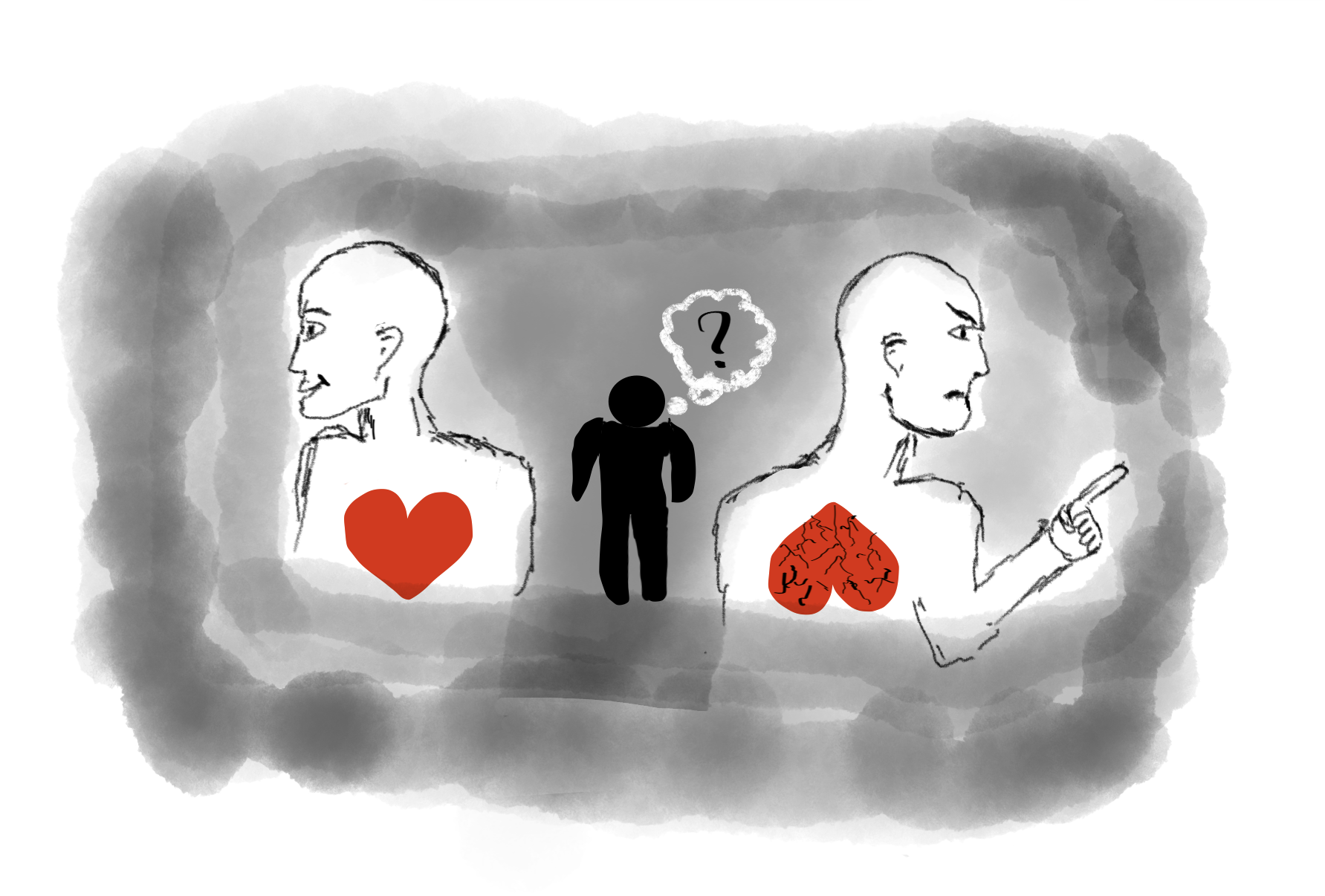
 Have you ever started to randomly hate the person you love? It can be scary at first to suddenly feel so negatively of someone you love. We, as people, have an intricate relationship with hatred, often tying into how we process things that may happen to us, how we think, and our biases against or for other people. Hatred and love function like a circular spectrum with both of them at the extremes, at times combining together. Love and hate, when they appear together, can have a convoluted impact on relationships. This spectrum is relevant to our daily lives, due to how heavily it can weigh upon our relationships. Emotions are often significantly more fickle, especially for teenagers, causing us to be even more impacted by this. There is always a point where your love for someone transforms into hate. The real challenge is figuring out where that point lies.
According to a study conducted by Wang Jin, Yanhui Xiang, and Mo Lei, the coexistence of love and hate in relationships has psychological roots. Their study is from a more romantic standpoint, however, attributing most feelings of hatred in relationships to lies and distrust among partners. Yet, the more love and attraction felt towards the person lying, the worse the hate for them was, and the hate typically appeared on par with, or even stronger than, the love.
What is the cause of such emotional fluctuation in your relationships? A study by Yale University argues that low self-esteem may be the cause. People with lower self-esteem view emotions as a binary between positive and negative, instead of viewing them as a range with more than just black and white. This causes them to see much more of the negatives as just negatives, without any positive aspects at all, making hate so much stronger. More so, this comes down to the way that you see and depict yourself.
This all ties together in your self-perception. The hate you feel for others is likely not true hate, but instead a projection of your poor self-esteem upon others. The worse you see yourself, the more likely you are to see someone you shouldn’t in a negative manner. That makes you reflect your self-doubt onto others. In this manner, you can become aware that your low self-esteem affects more than just you, but the people around you that you love, whether a lover or just a close friend. In reality, the lack of love you feel for yourself, and the more of that you pour into others, the greater the overall hate. So, what is the solution?
According to a book by psychotherapist Peter Michaelson, curing your own self-esteem is extremely complicated; it has to do with how you respect yourself. Having everything in the world doesn’t necessarily mean you will have high self-esteem, especially if you find yourself unable to have fun, to see value within yourself, and to see really anything good in yourself. Improving your self-esteem is eventually coming to love most things about yourself, and if possible, maybe even everything about yourself. To improve it, you must try to remove all negativity from yourself. Doing so would include giving yourself affirmations or choosing to spend time with people who support you more. Self-esteem still must be built up over time. It is a good investment for all of your relationships now and in the future. It takes a lot of will, hope, and overall work to make a genuine change.
I’m sure you’ve heard of a love-hate relationship before. That could sum all of this up pretty well. However, you might not have heard how the love-hate you feel could be tied into your self-esteem. Now is the time to implement that. You are filled with self doubt reflected as hatred. Over time, you learn to let go of some of that self doubt. Whether it is seeing yourself as a better person, or fixing flaws you see within yourself. Eventually, that hate is completely gone, considering that your self doubt is as well. When you repair your self-esteem, you still will feel hatred towards things, however, you can be sure that it isn’t just a reflection of the flaws you see in yourself, and instead something you can be sure of.