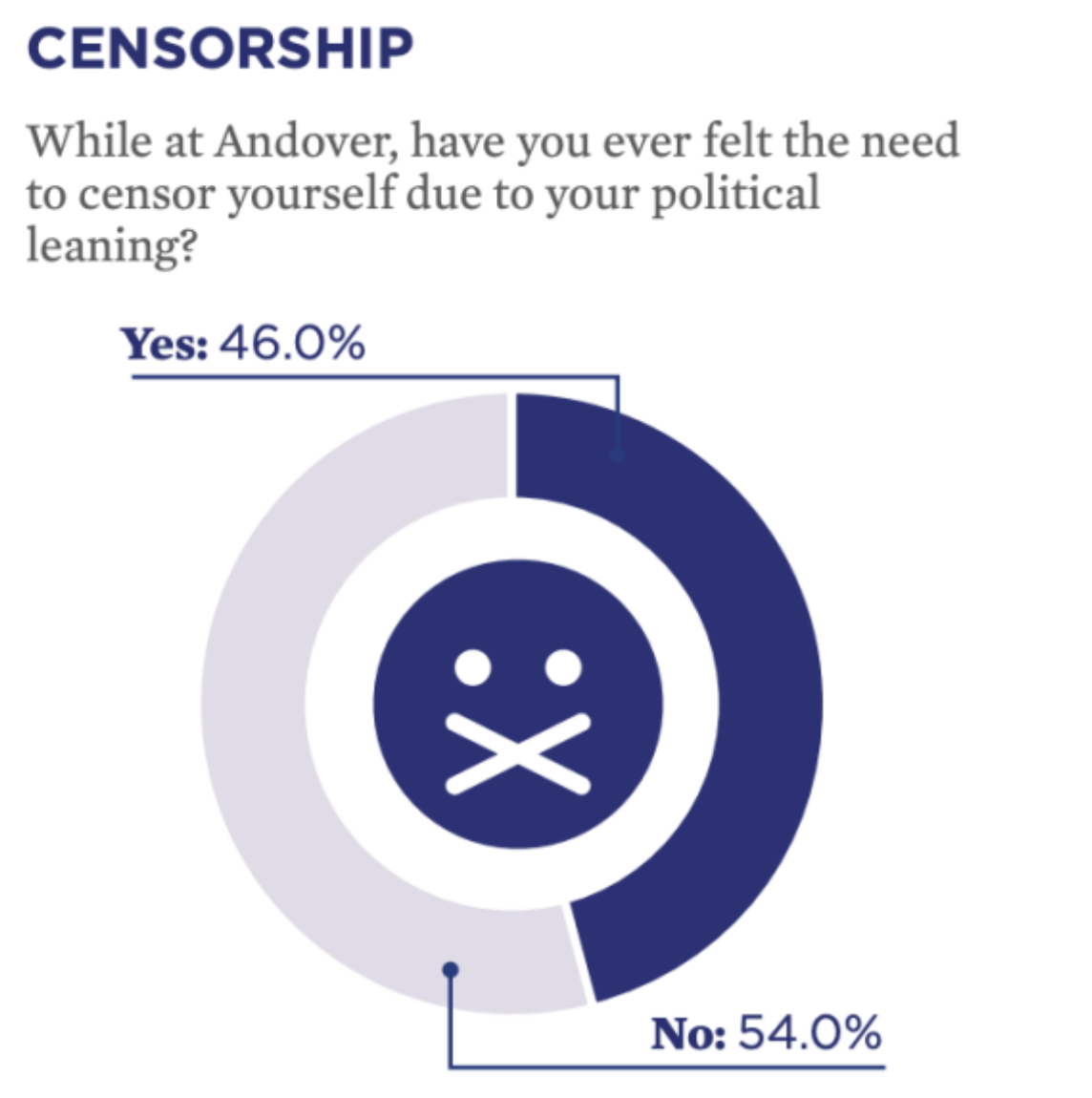
Data taken from the 2026 State of the Academy.
At a school that emphasizes knowledge and ‘youth from every quarter,’ the 2026 State of the Academy (SOTA) showed that 46% of respondents felt the need to censor their political beliefs and only 26% of respondents felt very or extremely informed on current events. Members of the Andover community reflected on civic awareness at Andover and how to augment it.
Sebastian Djerejian ’28, a board member of the Andover Political Union (APU), discussed the challenges of balancing the busyness of Andover student life with staying informed.
“There is not a lot of time to read the news just because we’re always so busy with homework. There’s not very much a culture here of staying informed, so there’s a little bit of an Andover bubble, where the outside world doesn’t really affect you while you’re in school,” said Djerejian.
Ashley Zhu ’29 rated her awareness of current events a three out of ten, noting that she rarely actively seeks out news.
“I don’t actively follow the news or search up current events,” said Zhu. “Many of the current events occurring are not near Andover, and everyone would live just pretty similarly if they don’t know what’s going on.”
Benjamin Levchin ’28, board member of APU and member of the Current Events Club, expressed concern about whether sharing his political beliefs could affect his academic performance.
“In recent years, I didn’t [hesitate to share an opinion about politics or issues at Andover], but recently I have because I realized that it either was affecting my grade, and whether that worry is rational or not, I would prefer to have peace of mind on it, but I think it says something about Andover that you can’t be certain whether it is,” said Levchin.
Anastasia Sycheva ’29 also described hesitating to express her political beliefs, citing concerns regarding interpersonal relations.
“If I’m speaking to someone who I know has opinions politically that are very different from mine, I wouldn’t want to share too many of my left-leaning political opinions with them because I wouldn’t want to offend them in any way or make the conversation uncomfortable,” said Sycheva.
Nicholas Zufelt, Instructor in Mathematics, Statistics, and Computer Science, observed that a lack of civil disagreement can cause individuals to refrain from expressing their beliefs for fear of what the reaction might be.
“As a society, we are struggling with assuming the best faith in the person you disagree with. That’s a skill that takes real work, and we haven’t cultivated it. That causes people to feel like they might get attacked if they share their opinion, so we all need to have better discourse around how we politely disagree,” said Zufelt.
Isaac Owodunni ’27, Co-President of The Current Events Club, said that the administration’s efforts to educate students on current events is inadequate. However, he cited a panel discussion held last winter as a step forward.
“On campus, there is not an administrative push to keep our students involved or develop our skills of being citizens. Something that was a good example of this was last year, when the History Department held a talk about ICE. They kept it strictly information-based to inform our student body of what was going on in the country and to answer any questions. It should happen more often,” said Owodunni.
He continued, “The way we become more comfortable discussing these issues is by discussing these issues. Students right now have had to form spaces and lead initiatives for these discussions to be had on campus, outside of what one might say with their friends. This school, Andover’s administration, should do more things like the History [panel], or maybe it’s hosting public forums or small discussion groups in history classes, where students can be encouraged to reflect on their views and learn how to substantiate them.”
To Camille Torres Hoven, Director of the Oliver Wendell Holmes Library (OWHL), students ought to be more informed than they are currently. She highlighted the school’s collection of resources related to current events.
“There’s many opportunities, even if it’s not taught in class, for students to get informed. Particularly, all students have access to [The] New York Times, The Economist, The Financial Times,” said Torres Hoven. “We have databases, and you can get The New Yorker, you can get conservative outlets, you can get liberal outlets. So [the lack of informed students] is a shame and maybe the library should push those resources out more,” said Torres Hoven.
Colin Phelan, Instructor in History and Social Science and faculty advisor to the Current Events Club, explained his perspective on the virtues and challenges that come with the integration of current events into the classroom.
“Instructors aspire for their learning, for their lessons and their units, to have applications in the world outside Andover. I know that instructors do consider how the lessons they’re leading can be extrapolated beyond the classroom, whether that means directly talking about a topic or exposing students to a framework or an idea that can apply to the modern day. I think we all try to do this. It also can be tricky by virtue of timing,” said Phelan.
Phelan continued, “I try and bake it into my classroom as best as I can for my elective [History 522] and then also with [History] 300, but there are also other pressures which challenge the incorporation of a current events structure into the classroom. For instance, I have to make sure there’s enough time for assessment.”
According to the SOTA, around 20% of Andover students are unsure about their political leaning. Jonah Malvey ’29, a board member of APU, commented on the importance of exploring different perspectives amid a polarized media landscape.
“What people are seeing right now is [that there’s] two extremes and no middle ground. I believe that most of the people at Andover and in the country in general are more centrist, and it tends to be the more hardline people that dominate the news and the masses. People do a good job at Andover exploring all perspectives, talking to different people, and then forming opinions and beliefs from that,” said Malvey.
Torres Hoven said she welcomes the uncertainty, describing her own experience of changing beliefs.
“20% unsure seems great, actually. More people should be unsure, like, ‘sometimes I feel this way and sometimes I feel this way.’ I had radically different ideas when I was younger. Part of that was my upbringing. And then I grew and I changed my mind several times throughout my life. And that’s okay. We’re all growing, we’re all learning. People switch parties all the time, people have different views about different things, different historical events when they learn more about it,” said Torres Hoven.