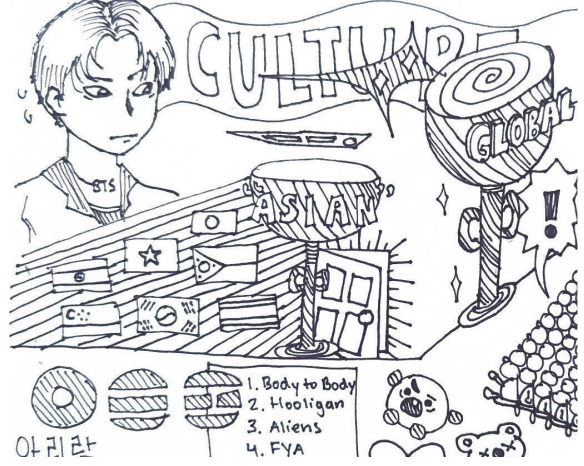
“Separate but equal” is arguably one of the most notorious phrases in American history. The phrase was associated with the Jim Crow era, which legally enforced racial segregation under the justification that separate facilities could be equal. Today, legal separation of people by race no longer exists in America. However, where the exact boundary between recognition and exclusion lies remains unanswered. The Grammy Awards is currently facing this question.
This July, BTS decided to refrain from submitting their new comeback album “Arirang” for consideration in the 2027 Grammy Awards. The cause for such unexpected action was the recently created Best Asian Pop Music Performance category. Six weeks after its announcement, BTS officially announced their decision to opt out of consideration for the award. Their reasoning was that “rather than music being divided by region or language, music itself [should] be heard and loved for what it is.”
The CEO of Recording Academy Harvey Mason Jr. responded to the group’s decision shortly after the announcement from BTS. Mason shared that he had envisioned that creating a separate category for Asian pop would open up more venues for recognizing Asian artists and culture. He also added that competing in the category wouldn’t restrict artists from competing for Grammy’s general fields, including Album of the Year and Song of the Year.
Yet his response does not fully resolve the question of whether or not the separate category could insinuate exclusion. Good will can result in ill-results, and the Grammy has had previous struggles to find the balance between recognition and categorization. For example, the Best World Music Album had to undergo a name change due to concerns that framing the vastly diverse global musical traditions as one category of “world music” gave the impression that Western Music was at the center, while every other genre existed outside of it. The issue didn’t stem from the fact that there was a separation in the category, but that the categorization implied a “center” and “outside” in artistry.
The new Best Asian Pop Music Performance category may be following the same direction. For example, Asia includes an extensive variety of ethnic groups and cultures. Grouping them blindly into one category would obscure and undermine the cultural diversity that the category is designed to celebrate.
More importantly, the requirements of the category do not seem to be centered on the music itself. The songs competing in this category need to include an Asian language that plays a significant role in the song. If the Grammy recognized Asian Pop as a genre, why is language a significant requirement? If other genres like rap or R&B music don’t cease to be rap or R&B even if they are in a different language, it is strange to make language suddenly a crucial factor in determining Asian pop.
As a solution to this, it might seem reasonable that artists who disagree with this category simply boycott it and apply for a different one. However, Grammy rules allow songs to be considered for a category that artists didn’t apply for. For example, an artist may apply for Best Pop Solo Performance, but may end up receiving Best Asian Pop Music Performance instead, if the submitted song fits both categories. Though it was explained that being awarded in the new Asian category doesn’t prohibit artists from entering the General Categories (Album of the Year, Record of the Year, etc.), it was never confirmed that artists would be able to enter other significant genre-specific categories like Pop & Dance or Rock & Metal while also being sorted for the new Asian pop category. This rule therefore makes the new category unfavorable for artists who want consideration in the more traditional categories instead.
This is where the historical comparison can be understood carefully. Obviously, the Grammy’s new category doesn’t come close to the malicious Jim Crow laws, a government sanctioned system of racial oppression through law and violence. However, the comparison does become useful when we consider Jim Crow’s underlying motto “separate but equal” and how separation can create hierarchy even when presented as equality. The recent Grammy controversy raises a smaller, yet conceptually related question: can the separation of a group by cultural identity change how the group is recognized and where they are considered to belong?
Interestingly, the Recording Academy has now begun reconsidering the category. Following BTS’s decision, Mason acknowledged that some Asian pop artists felt that the category didn’t properly acknowledge their music. The Academy has stated that they will consult artists and others in the Asian music industry on the new category.
The conclusion therefore does not rest in answering whether or not the Grammy category should exist. The category can become a door for less-recognized Asian artists like how the Grammy intended it to be. In contrast, it can also be a ceiling that communicates that their cultural identity determines where their music belongs. Separate categories don’t have to mean separate opportunities, but if separation becomes a boundary, the Grammy should be careful that their attempt to celebrate cultural identity doesn’t end up defining artists.