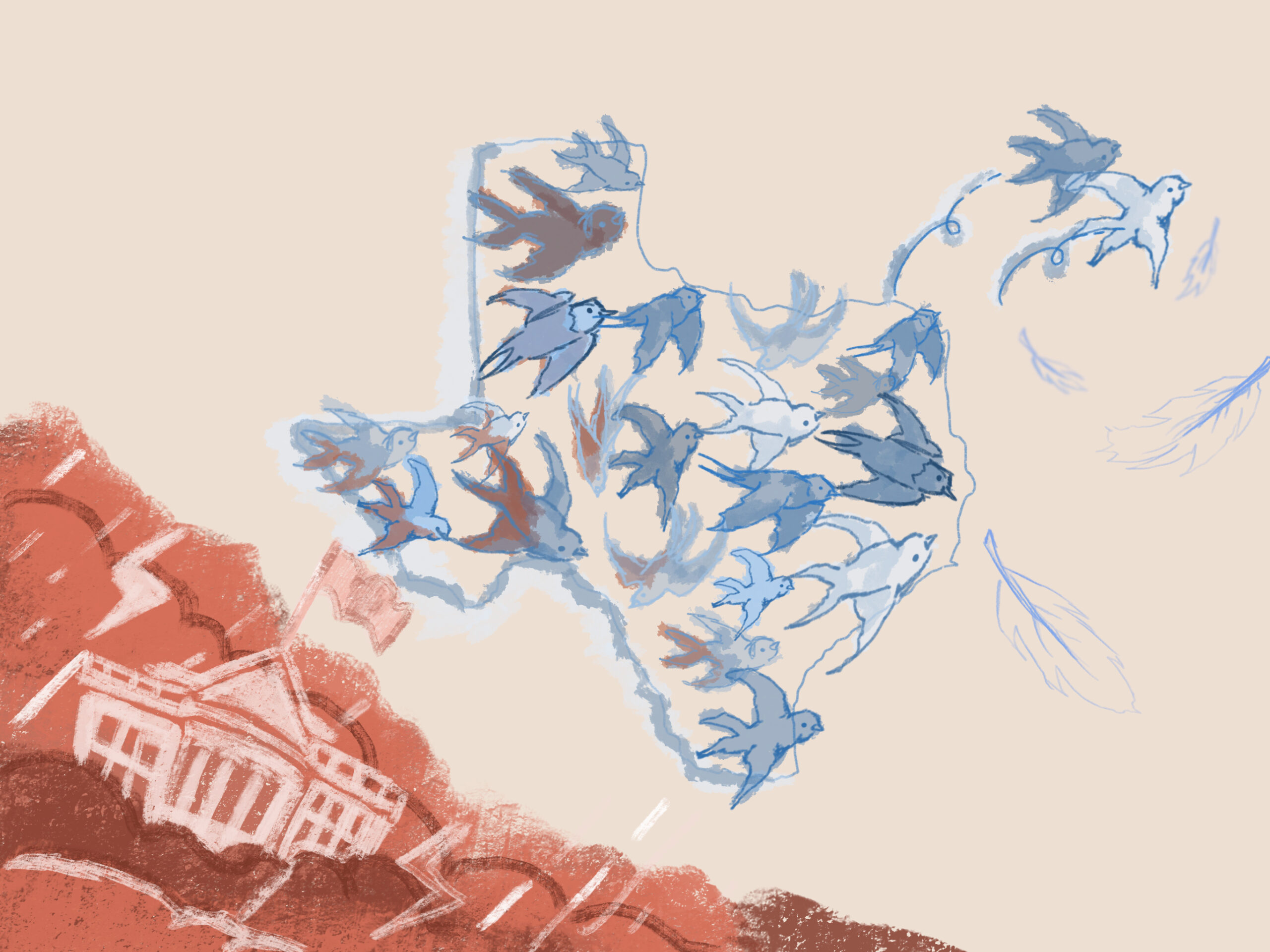
On November 3rd, 2026, the U.S. midterms had arrived, and by midnight, it was clear the Democrats swept the floor. At the time of writing, Democrats had flipped seven Senate seats, five governor’s seats, and 45 House seats. Thus, they’ve cemented an estimated 259 seats in the House and at least 54 in the upper chamber. Therefore, it’s hard to say this election wasn’t a blue wave. This redistribution was most alarming in Texas, my home state, where Democratic candidates James Talarico and Gina Hinojosa won the U.S. Senate and Texas governor’s race, respectively, with Hinojosa the first Latina elected to office. For many Americans, these staggering victories look like an absolute mandate for progressive politics. However, the foundation under this victory is much more fragile than the electoral results suggest. While the Democratic gains in Texas highlight the power of economic messaging and anti-Trump mobilization, they also expose a long-term weakness: a coalition built primarily against an opponent cannot sustain a governing majority without a unified, affirmative identity.
First of all, it’s important to talk about what happened to Texas. Tuesday revealed astonishing margins for Texas, a state President Donald Trump won by 14 points just two years ago. On top of that, all of the statewide offices up for election were won by Democrats. This shift may be in part due to the large mobilization of the Latino electorate, an evolution election analysis points to as a large part of the midterm shift. This analysis makes sense for Texas, which has a growing Latino electorate of over 6 million. The mobilization was most likely due to the change in rhetoric candidates used; in particular, they focused on affordability and capitalized on the economic struggles that Texans felt. For example, Talarico ran on an economic populist platform that hinted at lowering taxes and making corporations “pay their fair share.” Similarly, Hinojosa focused on homeownership and living costs. The reason this mobilization most likely worked was that the Latino population in Texas, a historically less affluent cohort, was hit severely by rising costs. Of course, the Latino community has also been impacted heavily by increased enforcement and Immigration and Customs Enforcement (ICE) raids, further eroding support for the Trump administration.
On the national level, the Democratic Party clearly gained a much wider range of voters, a shift that may complicate how the party operates going into 2028. Currently, the single unifying aspect of this broader coalition is opposition to the incumbent administration, whether it be the lack of economic policy or problematic executive overreach. This relies on negative partisanship—an alignment defined by shared opposition to a rival party rather than allegiance to a shared agenda. However, what does that mean for a post-Trump era? In the case Democrats win the presidency in 2028, discarding ICE, rolling back tariffs, and enacting social programs paid for by higher taxes, what happens next? If this negative partisanship can no longer bond against a Trump-esque figure, the democrats may not be able to maintain support.
We can actually learn how volatile these wide-based political movements are from Trump’s own Make America Great Again (MAGA) movement. In 2016 and 2024, he was able to pick up disaffected voters, mainly lower- to middle-class white and Latino voters. Initially, he promised to rid the U.S. of “elites,” to build a wall on the U.S.’s southern border, and to fix the economy. However, once in power, the Republican Party ran into trouble when balancing the wishes of various cohorts: fiscal conservatives, right-wing populists in the working class, and wealthier capitalists. For example, the Big Beautiful Bill, signed into law last year by Trump, consists of cutting taxes for the upper class and businesses, while decreasing social programs that usually help the working class. Granted, the bill also includes tax reductions for tips and tax deduction paths, but many speculate that generally, the benefits skew to wealthier individuals. Further, the bill’s cost angered fiscal conservatives over the U.S.’s debt burden. Now, the new anti-Trump coalition brings progressives, suburban moderates, the working class, and minority voters into a single party. And similar to Trump’s coalition, this one is just as vulnerable to competing interests. Fundamentally, negative partisanship is an effective tool for mobilizing turnout, but it fails to build consensus once the common opponent is out of office.
The main takeaway is for the Democratic Party to define itself. At the moment, the most visible politicians are on the left wing of the Democratic bird. Politicians like Zohran Mamdani are voices voters seem to like, despite the initial denial by the party establishment to back his candidacy in the New York City mayoral race. Of course, Mamdani’s success in NYC cannot be emulated nationwide. Nonetheless, to maintain momentum through 2028, the Democratic Party cannot rely on a fragmented patchwork of regional stars or reactive anti-Trump messaging. Winning Texas proved that economic woes can break traditional strongholds. Keeping the voters for 2028, however, will require Democrats to prove they can deliver above and beyond their promises.
For our generation, the next few years will be a test of political maturity. Our lives have been shaped by an era of extreme polarization, and young voters—who turned out in record numbers across Texas—have made clear that they expect more than just opposition to the status quo; they demand tangible economic relief. If the Democratic Party wants to turn a temporary anti-Trump coalition into a lasting governing majority, it must prove that holding power translates into real, material change for working-class families. A blue wave may open the door, but only a clear, affirmative vision will keep voters from walking back out.