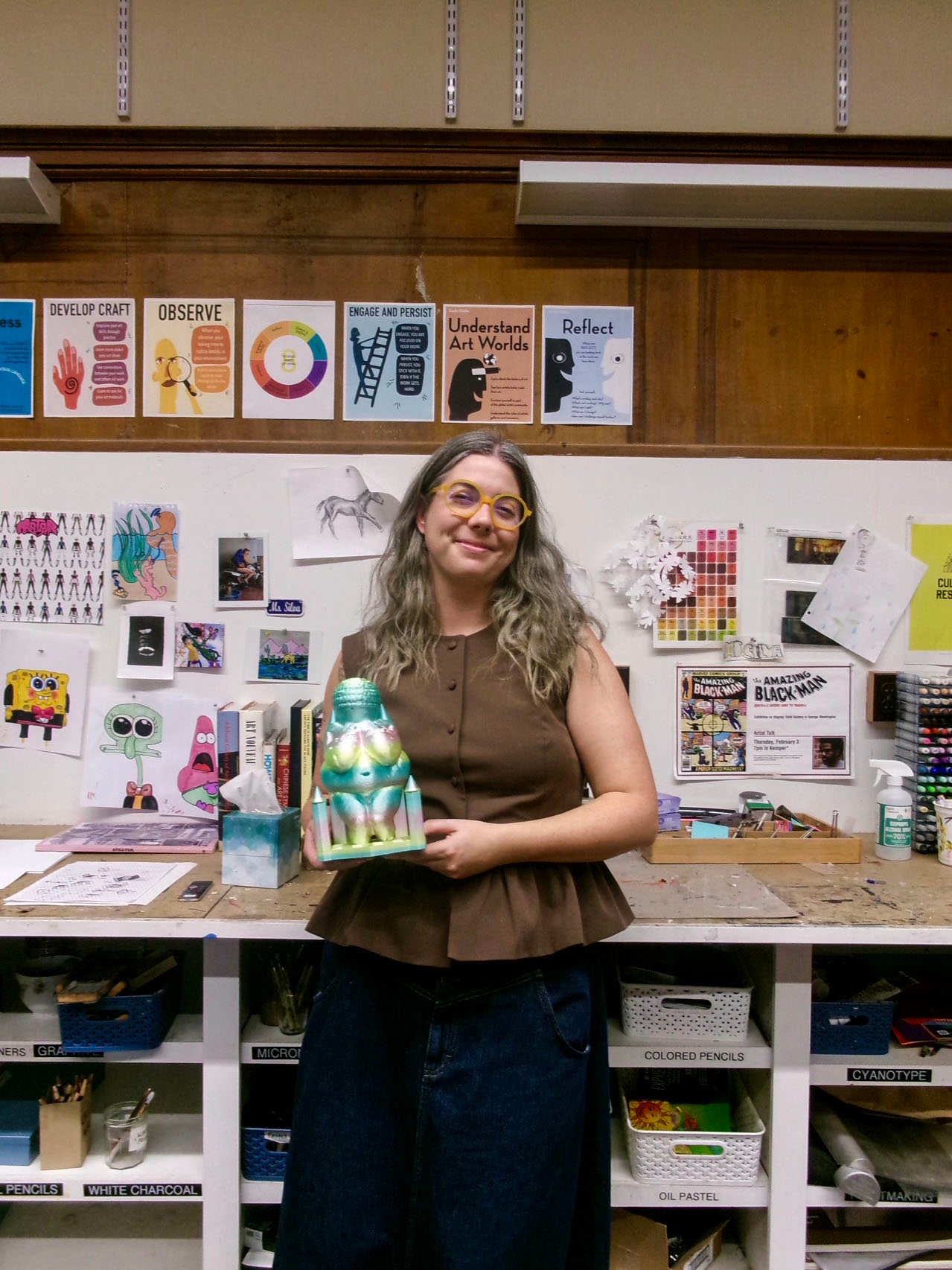
Renée Silva is an Instructor in Art. On campus, she advises the Intersectional Feminist Forum, coaches instructional volleyball, and resides in Smith House. Prior to and during her time at Andover, Silva has served as a visual art instructor across numerous private and public institutions, including the Massachusetts College of Art and Design. In their free time, Silva enjoys baking and going on hikes with their dog.
What initially sparked your interest in art?
I had a really great high school art teacher, and I was always really creative. As a young kid in elementary school, I went above and beyond for any art project and made very elaborate cards and gifts for friends for birthdays and [other] occasions. I took a class similar to Art 225 my freshman year in high school, and I loved the painting unit, and my teacher was like, “You should take more painting.” Once I started painting, it was all I could look forward to every day when I was in that class. She also encouraged me to pursue it in college and as a career. It has been something that has been increasingly invaluable in my life and something that I keep returning to, and it’s a big part of who I am.
What made you decide to teach?
It was kind of by accident. I went to the [Massachusetts College of Art and Design] in Boston and I went in as a double major with Art and Art Ed[ucation], but then I ended up dropping the Art Ed because I wanted to just focus on being an artist and do one thing at a time. When I graduated and was looking for work, I was just in the right place at the right time and got offered to teach painting at MassArt Youth Programs, which are for high schoolers who are serious about art and maybe want to go to art school. I loved it and I’ve been doing it since.
Have any specific people or experiences influenced how you thought about art?
My peers in college really shaped who I am as an artist. I have a friend who lives in Florida, and we’ll catch up on similar themes in what we’re working on. For example, I’ve been making a lot of work about Venus of Willendorf, which is a Paleolithic sculpture. There has been a lot of debate around it, but it’s generally an object of femininity. My friend was also thinking about dolls at the time and putting wigs on rocks as an interesting take on a doll, so he mailed me some wigs and then I ended up painting the wigs into some paintings. But then I have artists that really inspire me. Some of my favorite artists are Agnes Martin, Ken Hoffman, and recently, I’ve been looking at a living painter who’s in Chicago, named Celeste Rapone, who paints figures in a subtler way that acknowledges the rectangular canvas.
How have your experiences as a visual art instructor influenced the way you approach art education?
[Public Schools of] Brookline was a K-8 school, so I taught 7 different grades in one day. I have a wide lens on what different art looks like in different cultures, communities, and age groups. It was pretty similar to the facilities, rigor, and abilities of what students can do here. But I also taught in a charter school in Providence, Rhode Island, which was a different environment and community. What I care about as an artist is that kids can have an outlet and something that they can make a meaningful experience out of and take with them outside of the class. It can be inclusive to anyone. I keep my assignments pretty open-ended. I want people to bring who they are to the space and to what they make, have fun, and learn how to be bad at things and make mistakes, because that’s unavoidable in art making.
What drew you to teach at Andover?
I am sort of a townie. I didn’t grow up in Andover, but I grew up in North Reading, which is the next town over, and my family is all local to this part of Massachusetts. It was kind of like coming home after living in Providence, and mostly the art department drew me in because they’re awesome, our facilities and, of course, the students. I never thought boarding school would be in my future, but every part of it felt like a good fit.
Your teaching philosophy emphasizes inclusivity, community, and collaboration. Why do you encourage students to communicate and learn from each other?
It’s an increasingly important skill, especially as we feel so disconnected with technology. We’re losing humanity a little bit more every day, and art is a good way to touch grass, so to speak. You put your screens away, you’re dealing with oil paint, and there’s no undo button. You have to really confront the material, and in a studio space, which is usually a little bit different than a classroom space, it’s dependent on being able to support one another and be vulnerable with one another. Communication and collaboration are integral skills in life, wherever you go and whatever you do. The creative spaces are a really important way to learn that.
What do you hope students take away from your classes?
Using art to figure out who you are, because especially as teens, young adults, you’re really in the thick of that. Art is about doing something new, and there’s no right or wrong answer. Most of it is, how do you make something new that’s interesting and feels cared for? There’s something that you need to build in yourself to do that, and it also leads to your own artistic voice. What do you want to say? How do you relate to the world? Who do you make your artwork for? Thinking about the relevance of creation and how it helps foster things like community and communication.
Where do you find inspiration for your artworks?
A lot of different things. Sometimes it’s pop music, or reality TV, or a David Lynch movie, or a microaggression. My work is about creating a world where things like softness, femininity, androgyny, and abstraction can exist in a safe space. A lot of it is reactive to violence to see more liberation and freedom in the world.
How did you decide to get involved with the Intersectional Feminist Forum?
I was asked to be the advisor several years ago when Emma Staffaroni, who was the director of Brace at the time, needed to take a step back from it. She thought it’d be a good fit. I was already house counseling in all-gender housing, but my work has been made through a feminist lens too. It’s cool to have that space on campus where we can have hard conversations around gender, race, or class.
What advice would you give to Andover students, especially to those who are interested in pursuing art?
Prioritize putting art in your schedule, which can be a challenge, especially since art is usually a sixth course. But if you’re looking to pursue an art program in college, the portfolio becomes one of the most important things… good art takes time. You just have to prioritize it and own it. Same thing for me when I was in high school. You have to prove to people that it’s a worthwhile thing and that it is valuable. There’s lots of ways to make money and have a career in it too.