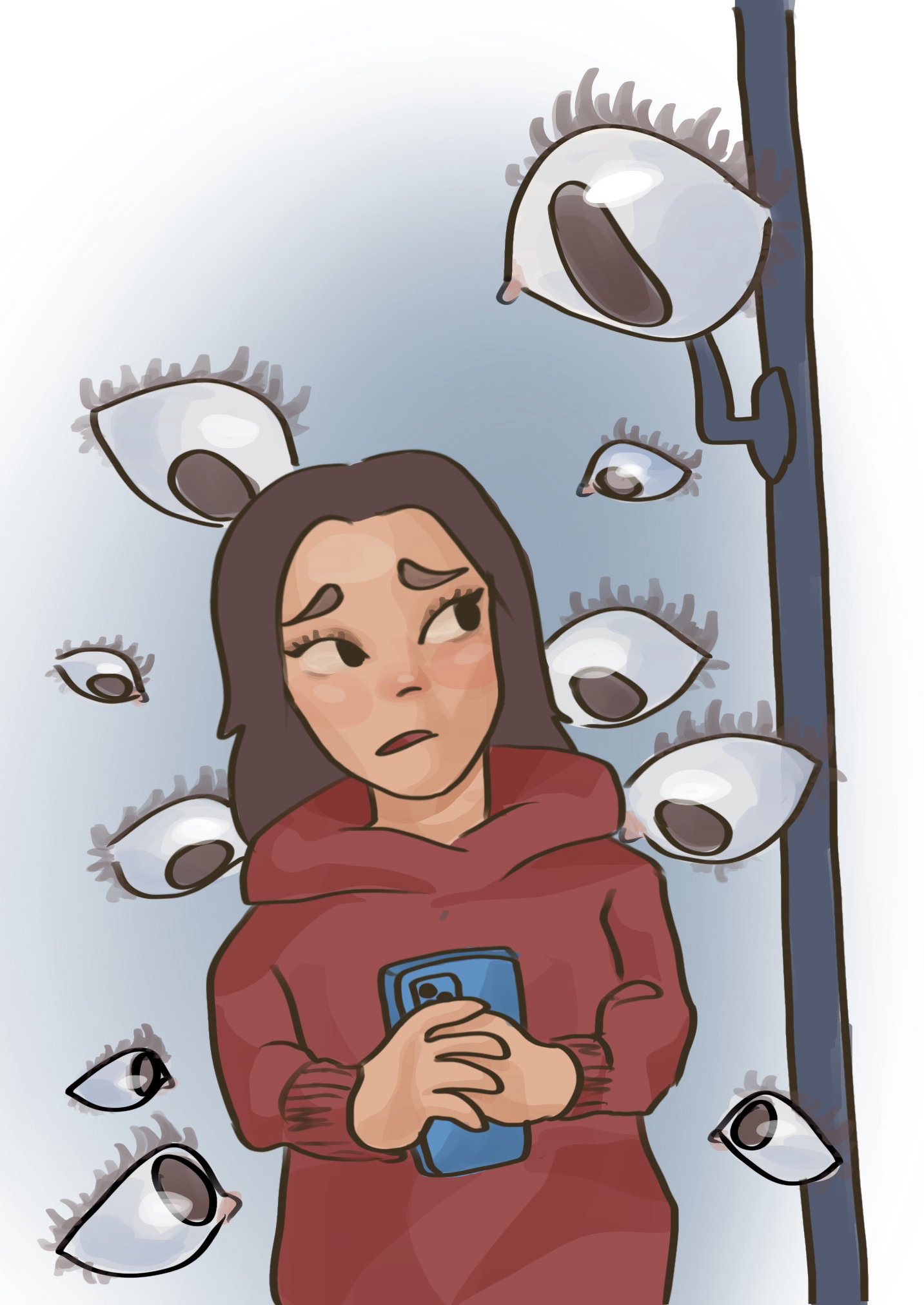
Someone’s watching you; someone has been watching you, perhaps for your entire life. Ever since you first touched a screen, the government, private companies, huge conglomerates, anyone with the ability, has been watching you. You probably forgot every time a website asked you one simple question: accept all cookies? Maybe you clicked yes and then carried on with your life. However, without even knowing, you just let that website access mountains of information on you.
But surveillance on this scale has never been able to escape the digital realm. Online, every click, every opened website, and every action is recorded, but this just isn’t possible in real life. A simple transaction at J.C. Penney does not share the same level of information. In the real world, all your private information is physical, like your birth certificate or your passport. But now a new piece of technology has emerged, one that bridges the gap between the internet and the real world: Flock cameras. Flock cameras are simple; they monitor roadways and track license plates. The camera then sends the license plate and the driver’s information to law enforcement, allowing police to know who’s driving where and at what time. These cameras are made to help police with investigations, but they can be abused. A New York Times article published in August talks about how three police officers were arrested for using Flock to stalk people. But to what degree does Flock change the level of surveillance in America? If people have been content with past methods, why push against this new one? Well, this new push against Flock isn’t new at all; it’s just an outcry against mass surveillance in general by both companies and the government that has been building for decades.
Even before Flock, the government was monitoring us. An article from Fordham University Law School claims that law enforcement had been accessing information on Americans’ private calls under Section 215 of the Patriot Act. This was in practice from 2001 to 2020; that’s a significant amount of time for the government to be accessing highly private information—around 19 years. When people first heard about it, they were outraged; they called for law enforcement to stop accessing their personal data through movements like the Stop Watching Us protest. But up until Flock, there hadn’t been any big protests or movements to try to minimize government surveillance. But that doesn’t mean people don’t care; according to the Pew Research Center, 71% of American adults are concerned with how the government uses the data it collects about them and 81% of people are worried about how companies use their data. People hate it, but they live with it nonetheless. However, there isn’t much they can do. After all, the internet is so crucial for work, shopping, and living; people can’t just stop using it.
Then flock cameras came around. They are the pinnacle of surveillance: reproducible cameras that can see someone and instantly recall a myriad of information about them. They act as a bridge, allowing the mass data collection from the online world to seep into the real one. Despite their advantages, there is one glaring problem with Flock cameras: they’re cheap, and they’re placed on weakly made metal poles that are less than three inches thick in diameter, with walls sometimes only an eighth of an inch wide. People have found a form of surveillance that they can combat. Videos across social media depict citizens fighting back against Flock cameras through any means possible. In one video, a man goes over the best tools for quietly and quickly cutting down Flock cameras.
To fight government surveillance, you have to do the near-impossible, and the same goes for data collection from companies and sites. But to fight Flock? Just grab a portable bandsaw from Home Depot and start cutting. Now that people can fight back against entities taking a look into their private lives, they are. This isn’t some one-time sporadic event; rather, it’s just a breaking point, a situation where people can finally speak their minds.
I dislike the fact that there are so many people who know so much about me. Personally, I think that some layer of surveillance, specifically government surveillance, is necessary, especially online. If you give everyone an infinite fountain of knowledge, at least a few people are going to use it for something malicious. Not only that, but the government needs to be able to have some amount of information on its citizens. Despite this, I believe that there has to be a limit. Conversations, calls, and messages should all be inaccessible. Even though accessing information about these things could, in theory, help prevent things like terrorism and crimes, it could also be easily weaponized, and if it were, it would be devastating. The same goes for Flock. Flock is undeniably useful; it can stop crimes and find missing people, but being able to constantly track every single American could be turned against the people in an instant. I believe that Flock gives up too much for too little. All it takes is one bad actor for everything to go sideways, and Flock isn’t worth that risk.
The fact that private entities can gain access to people’s private information so easily is horrible. People and their government should have an intimate relationship because they live under the government, but people don’t live under companies, and companies shouldn’t be able to form such personal relationships.
Flock cameras have brought the issue of privacy and security back to the mainstream, and people are fed up. This isn’t just a protest against Flock; it’s a protest against all forms of data collection. You may not realize it, but by simply existing in the modern world, this problem affects you. Andover students are just like everyone else; your data and your peers’ data are being constantly monitored. You have to know what’s going on so that you can choose how much you’re willing to give up for safety.