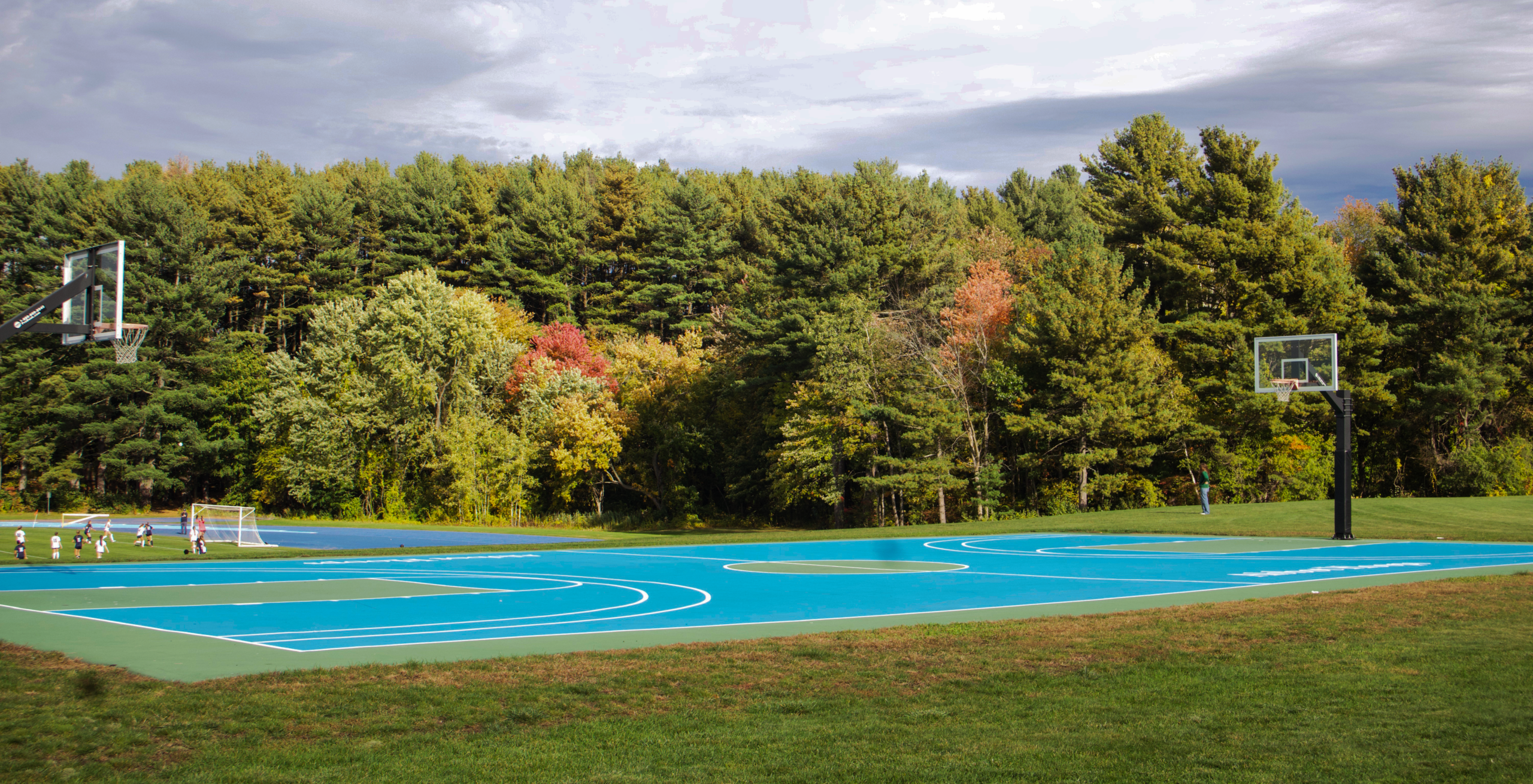
In 2022, the Abbot Academy Fund approved a proposal by Izzy An ’24 and Nathan Bechard ’24 to build Andover’s
first outdoor basketball court, Abbot Hoops.
Each year, the Abbot Academy Fund (AAF) invites members of the Andover community to propose projects that would improve life on campus, awarding grants that can range from $100 to $10,000. Students and faculty who were previously awarded an Abbot Grant shared how they identified unique needs at Andover as well as their approach to addressing them.
Christina Landolt, Instructor in Music, serves as the AAF Community Liaison, and works with students each year with the drafting of Abbot Grant proposals. She emphasized that the application period is intended to help applicants refine their ideas and identify the resources needed to carry them out.
“At this time, I try to help students find ways to make their proposal as successful as possible, sometimes encouraging them to rethink the scope or helping them identify campus partners to reach out to before applying. Applications are due October 26th at 5 p.m., and then proposers attend a dinner where they pitch their idea to the AAF board in person. They find out the results within a couple of weeks and then funds are available almost immediately,” wrote Landolt in an email to The Phillipian.
Amelia Ding ’28, founder of the Veterinary Medicine Club, observed a lack of dissection opportunities at the school. Her Abbot Grant allowed for more students to explore their interests hands-on while learning more about biology.
“I wanted to create more hands-on opportunities for students to explore animal anatomy and their interest in veterinary medicine, because I believe that there’s not a lot of dissection opportunities and biology classes. We’re hoping to use dissections to help people in our club to better understand how different organs help your body to adapt to the environment and how your system functions,” said Ding.
Ding hopes the project will encourage more students to join the club while giving them a better understanding of what studying veterinary medicine might entail.
She continued, “We’ve requested funding for dissection materials, dissection kits, and specimens. I’m sure that it’ll spark more people’s interest in joining the club and also help them have a better understanding of what studying veterinary medicine might be like in the future.”
Other proposals aim to improve the residential experience on campus dorms. Matthew Wei ’28, who is working on Campus Beautiful II, mentioned that his interest in the project began during his freshman year in Rockwell, when he noticed that the dorm’s common rooms lacked greenery.
“I lived in Rockwell my freshman year, and I noticed that our commons was pretty drab. One time at a random dinner, someone slid a bunch of slips on all the commons tables saying, ‘This is an opportunity. It’s called an ‘Abbot Grant,’ and I thought it’d be really nice to get plants for as many dorms as possible. We bought the plants, fully grown already, because we thought it would be easier, and we also chose some plants that were easy to take care of…That’s what the Campus Beautiful movement is,” said Wei.
Wei also encouraged applicants to pursue their projects regardless of scope, and to embrace failure with an open mind.
Wei continued, “I know a lot of people think their problem isn’t big enough or that the funding would be too much, but if you have a problem you want to solve, just go for it. The worst that can happen is that you go through the experience, you learn a lot of things, and then you can apply again next year.”
Landolt noted that successful proposals often focus on issues with broad impact. She emphasized that students are well-positioned to recognize everyday problems and develop solutions that might otherwise go unnoticed.
“The best proposals think beyond the individual creating the application and consider the impact of their idea on the larger community. Perhaps this is where the PA value of non sibi intersects with the AAF vision. I also find that students, staff, and faculty are uniquely poised to see solutions to the little things they see every day, and they can fix things that might not even have been noticed without them,” wrote Landolt.
Brian Wong ’27 sought to improve the badminton program after observing that the Snyder track surface caused multiple students to injure themselves while playing. His proposal, Badminton Team Development II, brought in portable court mats to make play safer.
“We were playing on the multi-surface track in Snyder, but it is not ideal at all for badminton because there’s not enough friction. [Badminton] includes a lot of rapid switch turns and brakes and accelerations, and five people were injured, including myself. People couldn’t really play freely without worrying that they would twist their ankle because of the surface,” said Wong.
Wong continued, “The suggestion I have is [to] be bold. A lot of people are scared about these hidden processes, but it’s actually pretty straightforward. You have to put effort and time into it, but once you walk down and see, there are plenty of people and resources waiting there to help you.”
Beyond athletics and residential life, grant proposals have also been created around initiatives on student safety and empowerment. César Dominique, Instructor in Spanish, is involved in a proposal for self-defense classes for girls and nonbinary students.
“Every woman should know some self-defense techniques because the statistics in this country are not different from many other countries where women are victims of violence by men. I’m not naive, and I don’t think that self-defense can prevent that from happening in every case, but I know that [self-defense] can be empowering for women,” said Dominique.
Dominique continued, “I would really encourage any student to [apply] if they really want to do something beneficial for the community. Typically, they get together and they create a community, and that has repercussions later because these people talk to other people, and it becomes something that empowers more people than the ones you primarily thought.”