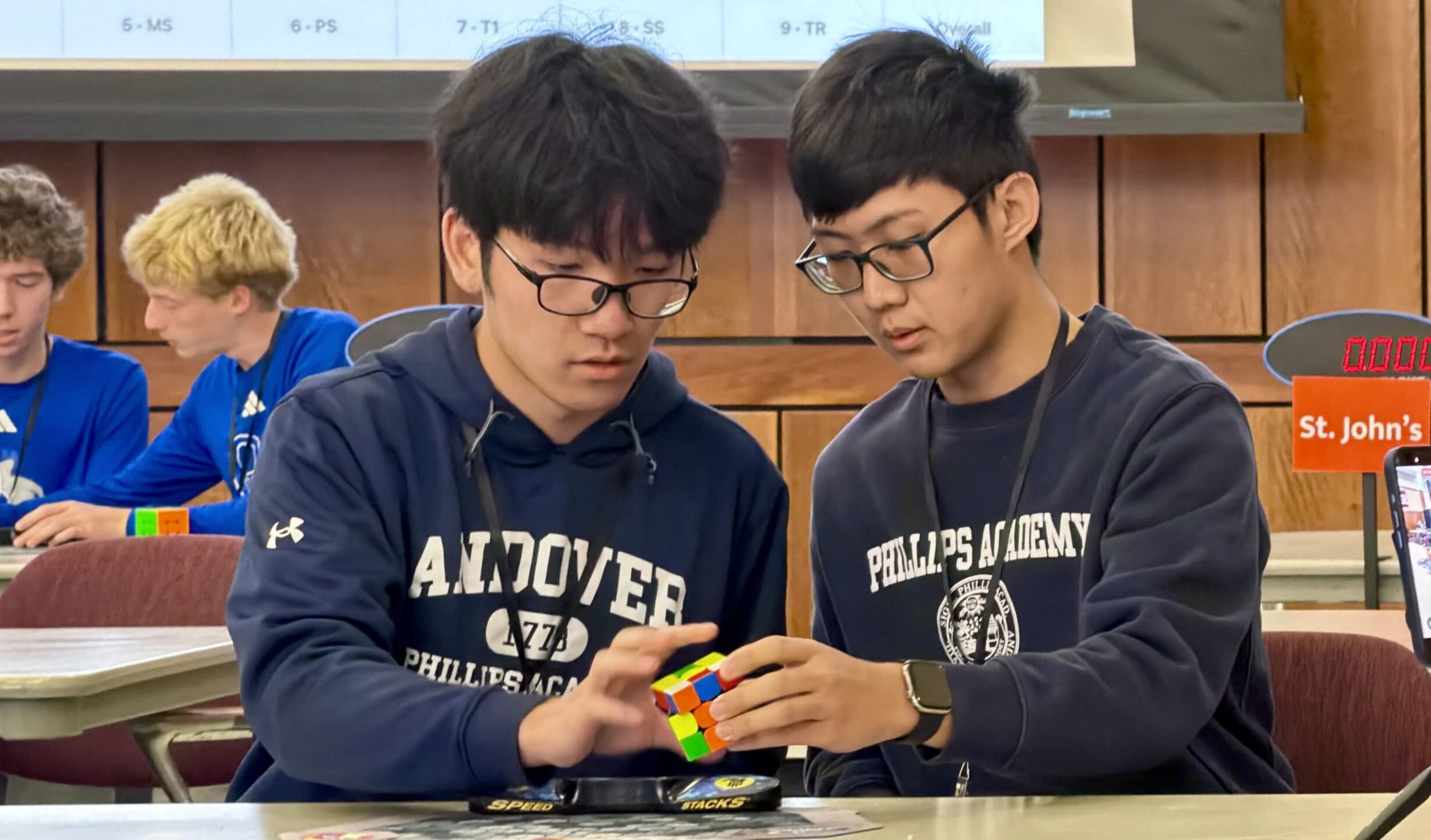
Oliver Zhang ’28 (left) and Robert Kong ’27 (right) study a Rubik’s Cube
before solving.
Last Sunday, Andover’s Twisty Puzzle Society (TPS) won the annual New England Interscholastic Speedcubing League (NEISCL) competition, hosted at Exeter. TPS sent two teams. The A team, which consisted of Robert Kong ’27, Oliver Zhang ’28, and Lucas Hernandez ’30, placed first among all scholastic teams. The B team placed fourth among all scholastic teams.
Robert Kong ’27, Co-President of TPS, detailed the scoring system of the competition and noted that the top teams were within a tiny margin of each other. According to Kong, a small time penalty prevented the second-place team from winning the round.
“The competition was very tight this year. The top three, which were Andover, Exeter, and an interscholastic team, were within 100 points of each other. There are a bunch of different events, and each event is out of 1000 points… The win actually came down to one missed turn. When you put down the cube and it’s off by one turn, that’s +2 seconds. The margin was like 1.5 seconds, so that +2 cost them the win,” said Kong.
According to Zihan Zhao ’28, this year’s competition saw an increase in student participation, featuring both scholastic and interscholastic teams. He described the origins of NEISCL and the expanded scale of the event.
“NEISCL is a competition that was created between Andover’s cubing club and Exeter’s cubing club to bring cubers from around the Northeast region and schools together. The competition expanded from last year’s NEISCL. This year, we hosted 15 different teams from around 10 or 12 different schools, including interscholastic teams of kids from different schools who didn’t have enough at their own school to compete,” said Zhao.
Oliver Zhang ’28 attributed TPS’s success to the team’s extensive planning, especially during the knockout tournament at the end.
“We knew we weren’t the best team there; winning was not easy at all. There was a knockout tournament at the end where the winning team steals ten percent of the losing team’s points every round. We were the only team that tried to calculate scores, and we had to devise strategies with other teams during the competition. That effort really helped us succeed,” said Zhang.
The competition offered an array of unique events, in which team members collaborated by giving verbal instructions or by controlling different sides of the cube at once. Hernandez noted that preparation contributed to Andover’s success in the events.
“Having gone to a couple of competitions before, I’m not used to the style of the Exeter competition because [it was] much more collaborative than just doing it by yourself. [In] one of the events, one person’s blindfolded and the other has to tell them what to do,” said Hernandez.
He continued, “Despite only meeting twice before the competition, we were able to meet efficiently and get things done and talk about who’s doing what. Prior experience helped as well, because it really takes a while to get as fast as some of our members are.”
Though Andover’s B team originally had three members, two of Zhao’s teammates couldn’t make it at the last minute. Despite the unexpected logistical changes, Zhao placed fourth among all scholastic teams and described the Pressure Solve round as a moment from the competition that stood out to him.
“My particular solve was during the event, Pressure Solve, where I had to place a guess on what my time would be. If my time is over my guess, then my score will be my time plus the difference. If it was under, then it’s just going to be the time I guessed. I ended up guessing 23.5 [seconds], but my solve ended up being 17.5 [seconds], so 6 seconds under my guess. That was one of my best moments,” said Zhao.
Hernandez also found the event to be an opportunity for community building. He bonded with students from other preparatory high schools with shared interests other than cubing.
“[I got] to meet other people with similar interests, but also who have gone through similar experiences going to schools like [Andover]. When you’re at a competition somewhere else, it’s a much more diverse background with one similar interest, but when you talk with the people at a competition like Exeter, you find out that you have more in common than just speed cubing, [such as] playing musical instruments or liking certain subjects,” said Hernandez.
Since Daniel Chen, PEA ’27, member of the Exeter speedcubing club and head organizer of the NEISCL competitions, is graduating, Andover will host the next competition in Spring 2027. While preparations have not yet begun, Kong shared that Andover will be coordinating with Exeter during the transition process.
“We’re hoping that we can get even more schools if possible. We haven’t really started preparing early, since it’s still quite far away into the future. Exeter’s cubing club is going to give us some materials, like the timers, trophies, their scrambling programs, all that kind of stuff, to us [during] Fall Andover/Exeter. Hopefully we’ll get to collaborate with them so we can have a smooth transition,” said Kong.