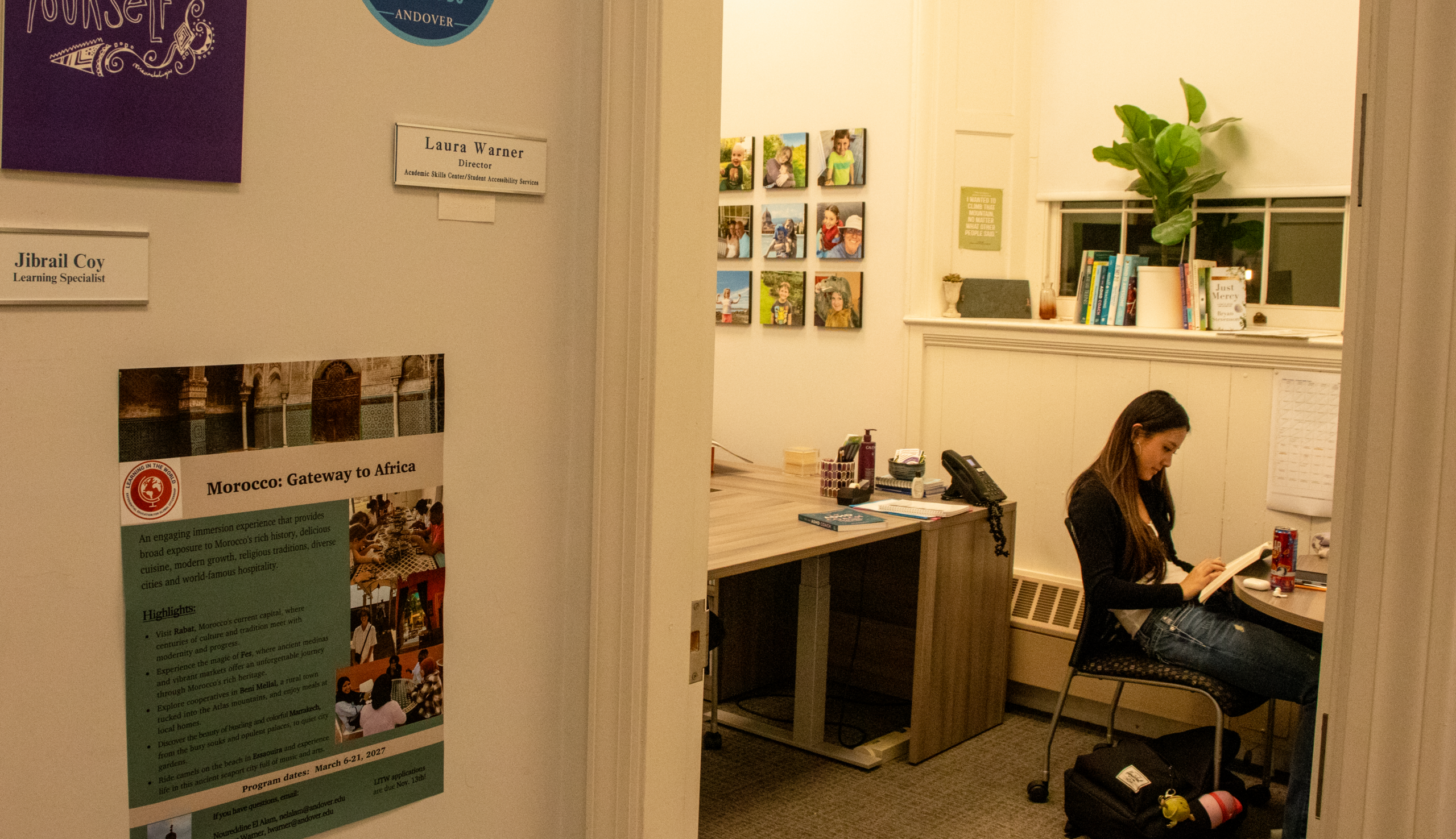
Doris Lu ’28 studies in one of the offices of the Academic Skills Center (ASC), located on the first floor of Pearson
Hall. The ASC’s relocation to George Washington Hall will feature more breakout spaces and whiteboard tables.
The Academic Skills Center (ASC) will relocate to the second floor of George Washington Hall (GW) in December. This shift in location follows the Dean of Students Office’s move to the second floor last January as part of an ongoing effort to transform GW into a centralized hub of student services.
In an email to The Phillipian, Laura Warner, Director of the Academic Skills Center and Student Accessibility Services, described the improvements that the new location will allow for and explained the renovation’s status.
“The new space has high-top seating, a couch, three round whiteboard tables, and it will have lots of breakout spaces for our evening peer tutoring sessions. The space is actually fully complete and renovated, and we are working on some final touches before our scheduled move. We will be moving after finals week, and will be fully operational in GW starting in December!” wrote Warner.
Kelley MacKinnon ’27 is a peer tutor for the ASC. She noticed that students are often crammed into the current ASC in the evening, and believes a larger space would resolve this issue.
“During group peer tutor nights [in Pearson], it’s very loud, overstimulating, and it’s harder to find a space to work. The benefits [of GW] would be having more space for offices and more spaces to meet. It would be awesome for students to come in to study and get help as they need, and for people to be able to spread out and have more space to work rather than sitting on the floor,” said MacKinnon.
On the other hand, Kalista Kuemmerle ’28 appreciated the ASC’s current location, expressing concern that the move would make the facility less accessible for the student body.
“[Pearson Hall is] very central on campus, so it’s very accessible. I go during my lunch period because it’s right next to [Paresky] Commons. Part of why students go is because it’s literally right there in the middle of campus, so [the relocation] might actually decrease the amount of people going to visit the ASC,” said Kuemmerle.
Linden Huang ’28 noted that this move would bring more student facilities into one building instead of dispersed around campus, making the services more cohesive.
“Moving to GW also allows it to become a more centralized student-focused hub. By relocating the ASC and the Dean of Student’s Office to the second floor together, Andover can bring student services into one location and make academic and administrative support more accessible to everybody. Right now, it’s scattered all over campus,” said Huang.
On the contrary, Gabi Perez ’28 observed that Pearson — the building housing the current ASC — is tangential to most students’ campus experiences. She anticipated that the relocation, along with advertisement efforts, will make the ASC more popular among students.
“Pearson’s a little irrelevant, as in you only really go into Pearson for either the ASC or if you have Greek or Latin. As a peer tutor, I see that people come in less compared to other study centers. Apparently Mr. [Randall] Correa is going to try and advertise the ASC more after the move to GW, and the whole point of moving is to have more people coming to the ASC,” said Perez.
Warner explained that one of the rationales behind this relocation is to make the ASC easier to access for students. She mentioned how the ASC faculty hope to increase visibility as students begin to adjust to the new location.
“We’re really going to work on trying to get students here within the first term, so that everybody can see the space and know where we are. We always leave our doors open, partly because we do have an open door policy, and we are hoping to just make it really visible once we move,” said Warner.
Huang emphasized the importance of communication during the transition period, ensuring students still know where to access ASC resources.
“The biggest concern I have is ensuring that students can continue to access the ASC services seamlessly during the transition. Because students may rely on the center for support during particularly demanding periods of academic year, it’s important that the relocation doesn’t disrupt their abilities to receive help when they need it. The students need to be made aware of the new location and any changes to how the services are provided,” said Huang.