Following a civil lawsuit alleging sexual assault against seven Cornell University students, members of the Andover community are re-evaluating campus culture and institutional responses to gender-based violence. In the two weeks since The Cornell Daily Sun published an editorial addressing the lawsuit, national media coverage has prompted discussions on consent, rape culture, and support systems amongst Andover students and faculty. At time of publication, official, school-sponsored programming in response to the case has yet to be announced.
A community discussion was provisionally scheduled for Tuesday on the Brace Center for Gender Studies (Brace Center)’s website. Patricia Har, Director of the Brace Center, stated that the event has since been postponed to allow for additional planning. According to Har, opt-in community conversations will likely be officially implemented by the end of Fall Term.
“Ideally, first conversations may be separated by gender and gender expansive folks would have the opportunity to [attend]… wherever they feel most comfortable. Opening a space for this conversation is important because it can signal to everyone that this is a school where we’re going to talk about the realities of sexual assault and sexual misconduct because it’s important to train ourselves to have a vocabulary to support anyone who experiences sexual violence, and also to educate folks before something happens,” said Har.
The current lack of scheduled school programming has drawn concerns from students seeking immediate engagement with the case. This week, a scheduled discussion for Junior advisories regarding consent was postponed due to conversations surrounding the Cornell case. Anina Buck-Thompson ’30 expressed her thoughts on this pause in programming.
“I have not had any discussions in any of my classes or in basically anything sponsored by the school. I did hear from my advisor that they were supposed to, in advisory earlier this week, discuss things related to consent, but that they ended up postponing it because of the Cornell case, because it might be a difficult time for people. That’s really counterproductive, because if you’re in a moment where people are suddenly discussing sexual assault, which is a really huge issue for a lot of institutions and Andover, I don’t think avoiding it because now it’s public is a good strategy,” said Buck-Thompson.
In solidarity with the anonymous plaintiff, survivors of sexual violence have begun sharing their stories on social media, with some choosing to start videos by stating “I am Jane Doe.” The online movement prompted alumna Cate Cummings ’26 to speak out publicly regarding her own experience at Andover.
“With the media attention on the Cornell case, I thought that this would actually be a perfect opportunity for me to come out with my story in solidarity of Cornell, but also of all of the survivors… Because of my Jane Doe video, past Andover [alumni] have reached out to me, letting me know that they have experienced something similar… I’m glad that it’s collectivizing and almost inspiring others to share their own stories,” said Cummings.
Susan Esty, Dean of Students and Residential Life, noted that administrative planning thus far has focused on tailoring support within established spheres of student life.
“We are meeting to think about a broad response, but being sensitive to the fact that… it’s an issue that different people experience differently. In a community our size, it’s hard to address things en masse. It’s really nice to create [opt-in] spaces with adults where people can process in a group that already feels safe to them, whether that’s [the] classroom or advisory or dorm,” said Esty.
The Intersectional Feminist Forum (IFFo), a student-led club, organized a meeting to discuss the Cornell case on Thursday. Anastasie Sycheva ’29, a board member of IFFo, observed that, while social media posts have been circulating widely, structured dialogue on campus remains sparse.
“I’ve seen a lot about it on social media. Everyone’s been posting it on their Instagram stories, but I haven’t actually seen… too many people actually take action. I haven’t really heard of anyone or any groups particularly trying to… address if something like that happens here at [Andover], which we know now that it has in recent years,” said Sycheva.
She continued, “It’d be great if [IFFo] had more attendance and more people coming. We’ll be discussing how to deal with something like this if it happens at [Andover], and how this impacts society. So what students can do is just engage in these conversations and work to really foster an environment at Andover where it’s a normal thing to talk about cases like this. That way, it becomes more acceptable and easier to fight issues like this.”
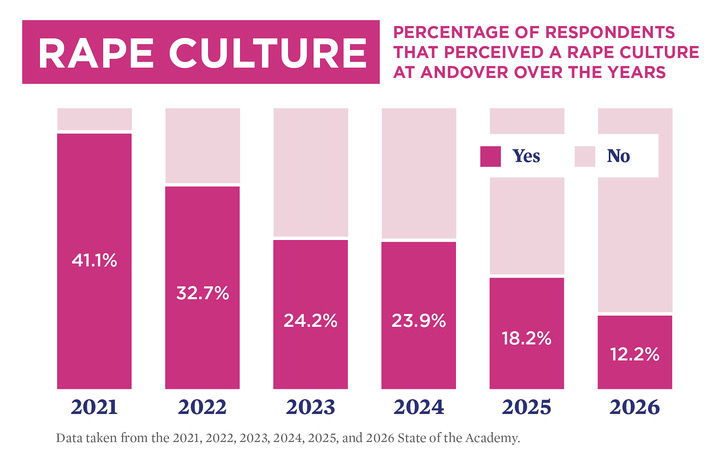
According to the 2026 State of the Academy survey, 12.2 percent of respondents perceived a rape culture, defined by the Oxford English Dictionary as “a society or environment whose prevailing social attitudes have the effect of normalizing or trivializing sexual assault and abuse,” at Andover. This marks a significant decrease from the 2021 survey, in which 41.1 percent of respondents affirmed its existence. Cummings emphasized that addressing rape culture requires a comprehensive education, something that she believes Andover currently lacks.
“In [Physical Education] and in biology, we learn about sexual assault. But are we actually being trained in what to do when this happens? At least for me as a student, I never got any sort of proper training. I don’t think Andover gave any sort of education to the student body that even brushes the surface of what this rape culture is. The first thing Andover and any institution should do is build into the curriculum a course on rape culture. That needs to be very heavily embedded, especially since you are teaching teenagers who are growing to be adults,” said Cummings.
Eric Nie ’26, an alumnus who is currently a freshman at Cornell, reflected on the extent of his consent education at Andover.
“I don’t think we had a lot of conversations about [sexual assault] at Andover. In EBI once there was the talk about consent. Every school talks about consent culture… but the lessons that you learn inside the classroom don’t necessarily apply that well. It would have been good to have more discussions at Andover about these kinds of things,” said Nie.
Buck-Thompson urged for greater guidance from the school as students navigate the Cornell case and its implications.
“It would be great if they could open up more of a school-sponsored discussion. This is happening in clubs, so those are more student-funded. The school should work on having discussions about both the Cornell case [and] just sexual assault in general. It’s a huge moment where a lot of people are opening up about a lot of their own experiences, and a little bit of support with that would be helpful,” said Buck-Thompson.
Eric Denby, Instructor in History and Social Science, emphasized the responsibility he feels to utilize Andover’s training and provide support for students.
“I think many campus adults will address this in some way, whether in small-group discussions, one-on-one talks, or even larger gatherings. I’m willing to do so with anyone who wants to talk about this topic. I believe it is my duty to provide support and guidance to my students… I do think Andover does a good job of providing training and resources to campus adults. Every year, we receive training on boundaries, consent, and our legal duty as mandatory reporters… Could we have more? Of course. Maybe a town hall forum or another open talk format would help address this moment specifically,” wrote Denby in an email to The Phillipian.
When considering both institutional and student-led programming, Jason Cai ’28 highlighted the importance of reaching broad engagement across demographics.
“It is shocking because in [IFFo] there are usually no guys that show up. And the one time I went, there were two out of 20 people. It’s just a little sad, because… we really need to have more people involved in this, because otherwise, it’s just a bunch of people talking to themselves over and over, and the message doesn’t really get too far. When you have more diversity within the listening body, the ideas that you’re trying to spread will reach a broader audience,” said Cai.
As students and faculty navigate discussions on campus culture and support systems, Har noted that several centers and offices are coordinating an institutional response.
“We have the Dean of Students, we have [the Rebecca M. Sykes Wellness Center], we have the Brace Center, all working together to use our spheres of influence to respond to this moment in time. If something is systemic, we’ve got to use the system to respond to it. We’ve got to use the institution, all the force of it, the power of it, to respond,” said Har.
For Nie, ongoing demonstrations at Cornell have underscored the crucial role of student advocacy across school campuses.
“We have this ability and this responsibility to do our part in taking action. Some coverage, or too much coverage, is better than no coverage at all. It’s important [to have] people be aware of this and do what they can, even if they’re not at the place where it physically happened,” said Nie.