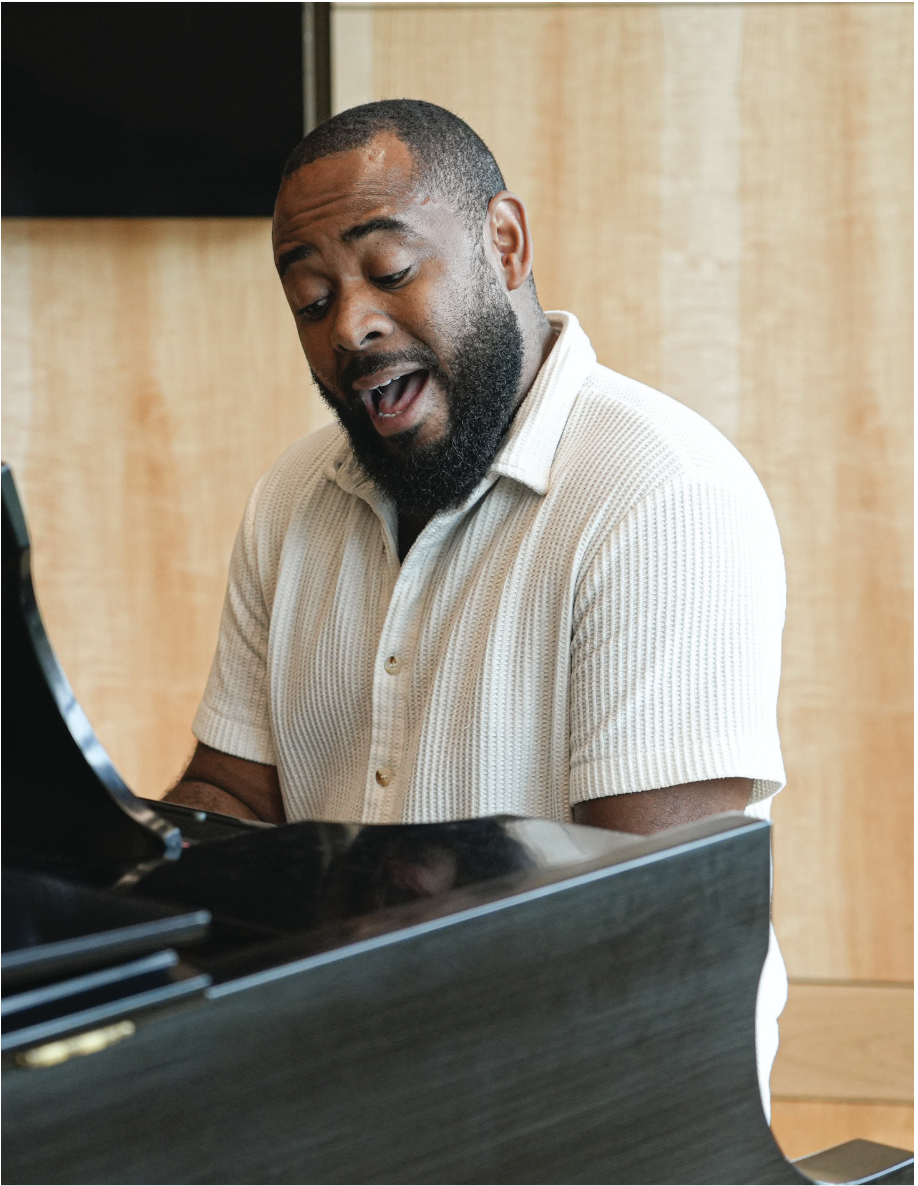
Trey Dugger (he/him) is the Director for Jazz and Contemporary Music at Andover. Before coming to Andover, he taught band, orchestra, and music production at The Fay School. As a multi-instrumentalist, Dugger plays the trombone, piano, drums, and sings, and he has also directed theatrical productions in the past. Outside of teaching, he enjoys spending time in nature, going to concerts, and spending time with family.
You have played many instruments before, including the trombone and the piano. Which is your favorite, and why do you enjoy being a musician?
I play the trombone, the piano, drums, and I sing. I love them all for different reasons. The instrument that makes me feel most like me is my voice, because I started singing at a young age in Queens, where I grew up, in my church. Playing the piano at a young age was also part of my journey [and] playing the drums for the church. Then I played trombone for my middle school and then continued on in college. But singing is something that I truly, really love to do along with playing piano to accompany myself because words are powerful as a melody, as a message. And so using my voice to convey a message of love, hope, despair, joy, or anything is one of my favorite ways to emote and share my joy of music.
Prior to coming to Andover, you taught band, orchestra, [and] music production classes at the Fay School. What did teaching a younger group of students teach you about music education?
Teaching young students taught me how to be patient and methodical in my practice. Progress can move at a slower pace, so keeping students motivated and feeling good about where they are is important to keeping them as musicians. The physical and emotional ages of young students can often direct or impact your lesson and expectations, but the overall hook for teaching at that age is making it fun and making them believe that mistakes are not a bad thing, it’s not scary. We’re all here to learn and become better musicians.
Is there anything that made you want to come to Andover specifically or anything that really inspired you to work here?
[Fay was] the only independent school experience I’d had. I heard about the Andover institution, and I’ve had many students from Fay go on to Andover. And so those students have always been exceptional, hardworking, and kind. Really great students, really great community members. This school has so much history, support, and phenomenal students and faculty. So teaching at a school with this level of excellence has always been a dream of mine. Also, you can’t beat this amazing Falls Music Center. I would say, this is the pearl of a school, it’s a beautiful building, as are many other buildings at the school, but I’m definitely partial to this experience here, because it’s a wonderful, wonderful place to learn and make music.
What are some important things that you hope your students take away from your classes or direction at Andover?
I hope the students love making music with their peers and performing for our wonderful community. Some of my fondest memories include performing with others, and I hope to motivate students to want to be their best as musicians or practitioners of the arts, and continue to spread the joy of music in supporting the arts on our campus and in the world.
If you could add anything to the Andover music experience, maybe a class, a performance, or a group, what would it be?
One of the things I really loved doing [in college] was playing with all the trombones in my studio. So we had this thing called the trombone troupe. It was about 30 trombones, and we would all play arrangements for the trombone choir. And that was a lot of fun because we just focused on our sound and the tone and the beauty of the trombone. I’ve heard many other ensembles that are unified instruments, like a flute ensemble or a saxophone ensemble. So it would be cool if there is a way for students to get involved in these spaces and play in ensembles that feature one instrument or instruments in the same family.
What is your best advice to a student who’s interested in playing an instrument for the first time?
You have to consider what sound you like the best. So listen to a lot of different instruments being played at high levels and choose a sound you like the best. Then, when you decide what instruments, you have to understand the steps and the time and the investment that there can be in learning this instrument. So you want to ask yourself what goals you have for yourself playing this instrument. Is it a fun thing? Is it for a hobby? Is it for a profession? Are you trying to be famous out of this? All those things you need to consider before you get into that. And it’s important to find an excellent teacher that can help you learn the right way, going through fundamentals and all the nuances of that instrument. The last thing that every musician and artist has to think about and discover is how you yourself practice and what you do in your artist spaces, in the studio to get better at that instrument, and how much time you give towards that.
Are there any musicians or musical artists that inspire you?
Duke Ellington, J.J. Johnson, Stevie Wonder, Sam Cooke, D’Angelo, Jacob Collier, Snarky Puppy, Brian McKnight, Take Six, John Batiste, Quincy Jones, Gospel artists like Kirk Franklin, there’s a lot that inspire me. The music that inspires me moves my soul. So whatever the message is, it could be love, it could be about religion, it could be about heartache, if it moves me in some way, I am inspired by it. And if I feel like I can sing along to the music as a vocalist, that always brings me joy. A lot of the musicians that really inspire me are vocalists, or they are composers, like Harry Connick Jr., Wynton Marsalis, Duke Ellington. So as a musician that plays several instruments, it’s fun to listen to those compositions and imagine what I could do as a composer.
You have acted and musically directed in musicals like Rent and Hairspray. What did you enjoy most about these experiences and how do you think your experience in theater connects to being a music educator?
Being a teacher is theater. If you can grasp the attention of the class and hold them in the palm of your hands and make them really believe and feel whatever you’re teaching, you can teach anything. It’s something as abstract as early swing music or music theory. The way I perform as a teacher is really important. So I think a lot about my eye context, body language, and how I project my voice. It’s all acting. You obviously have to know the content and know what you’re teaching as well, but it is a [performance]. And some of my favorite teachers have had an excellent way of commanding the room and keeping students engaged. That’s really important.
Outside of your professional life, what do you enjoy doing in your free time?
I enjoy being in nature. I lived in Vermont for a while, and so I love hiking. I love kayaking, being in the woods. I love having bonfires, hanging outside. I love grilling and cooking. When it’s summertime, I’m always out there on the grill cooking. I love playing basketball. I’m a huge basketball fan. Go Knicks. I enjoy just being with friends and family and doing the things that we all love to do with our friends and family, socializing, gathering, eating, and relaxing. Going to concerts is a big part of my joy. I try to go to at least three or four concerts a year, and all different artists, ones that I like, ones that my wife likes. I really enjoy going to musicals. I love the arts and I love a good time with friends and family.
Do you have any advice for aspiring students at Andover who hope to pursue a career in music or teaching music?
If you want to pursue a career in teaching or be a musician, you just have to practice. That is the number one thing, and you have to really fall in love with discovery and practice and challenge. Musicians go to those [challenges] and push themselves, and going through that struggle is really important because it makes you a better musician. I would also say listen to as much music as you can. Don’t close the door to any style of music. Learn any style of music, or listen to any style of music. If you were to look at my Spotify Wrapped, it looks crazy. I listen to everything and anything. And it really informs me as a musician and as a composer, and it allows me to have an open mind when it comes to music and what you hear, because music is this great universal language. And if you try to say, I’m going to only learn this part of this musical language, it only stifles your grasp of the whole thing.