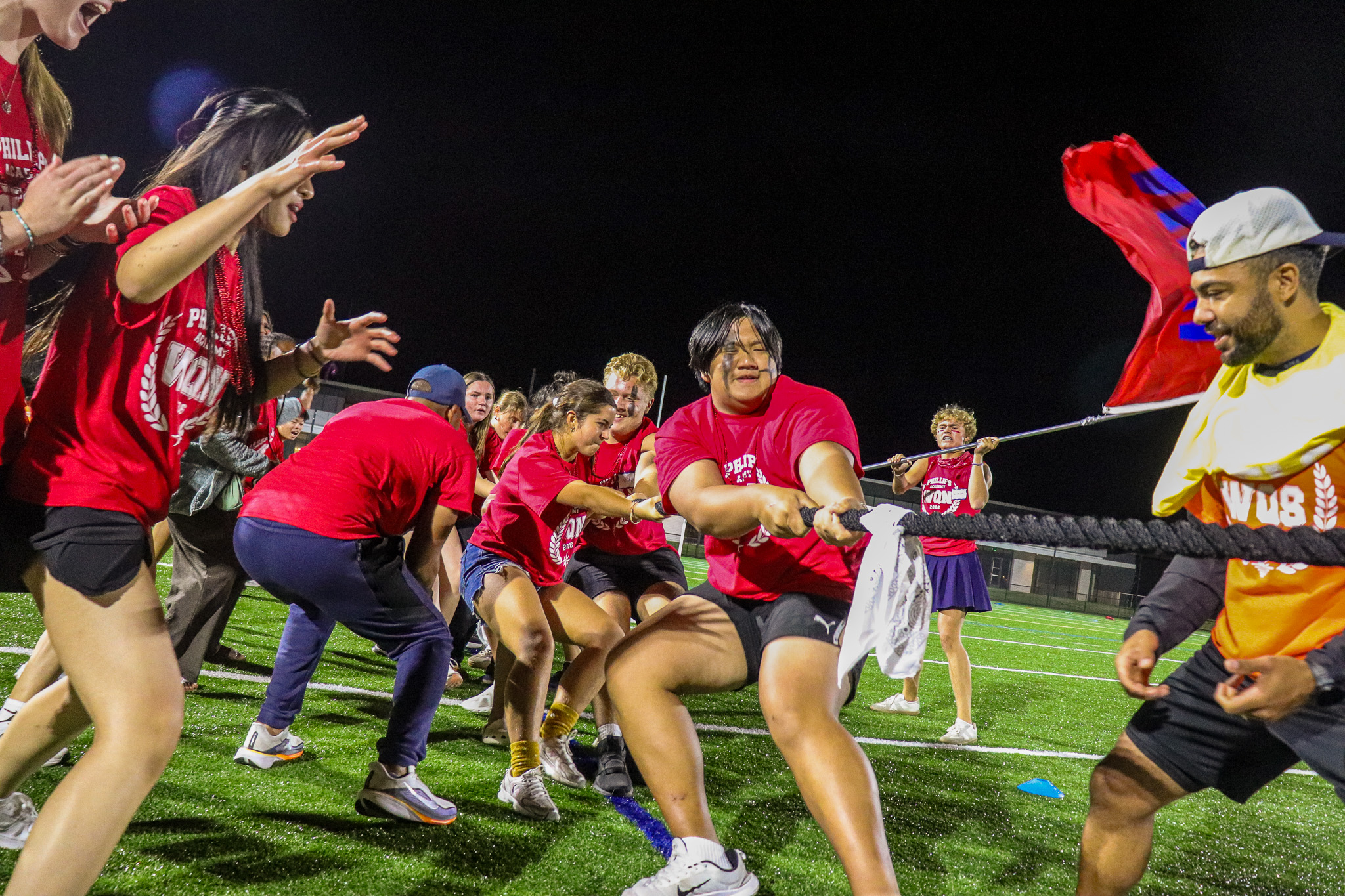
The West Quad North tug of war team demonstrated grit at Saturday night’s Cluster Olympics.
Draped in vibrant colors representing their Clusters, students marched into Phelps Stadium for the third annual Cluster Olympics. Captains and representatives hosted a series of chants and dances, and students rooted for their Clusters as they competed in various games, including Capture the Cone and Tug-of-War.
Although Cluster Olympics is mandatory for all students, the atmosphere was designed to make it feel less like a requirement and more engaging, according to Selene Xu ’27, Cluster Olympics Student Coordinator. Xu explained that she kept this in mind during parts of the planning process, including gauging student opinions.
“The most challenging but also most rewarding part was turning it from mandatory fun to genuine fun, because I know that for many mandatory fun events, not a lot of people are excited about [them]… If you’ve been here for a couple of years, you might just think it’s an extra commitment that you have to go to. That was my main goal from the start. I wanted to turn it into a place where people actually had fun, and I hope that happened. It was great because we asked kids for their opinions on what they wanted and what they didn’t want, and had a good committee that helped combat that problem,” said Xu.
Aya Murata, Assistant Dean of Students and Residential Life, noted accessibility as a major area of improvement from last year’s Cluster Olympics.
“Because we knew the Tug-of-War is popular, we did it so that [Juniors and Lowers] had an opportunity, and then Uppers and Seniors had an opportunity… We were trying to find ways to have as many people be able to participate. That’s why the potato sack races could have had up to 30 people. But in retrospect, that felt too chaotic. We probably will have potato sack races, but just not as many kids. So, it’s a little bit of both, and you want a lot of people to have a chance to participate, but you just can’t have it be [chaotic] on the field either,” said Murata.
Anastasie Sycheva ’29, reflecting on her Cluster Olympics experience last year, appreciated this year’s improved organization.
“Last year, it wasn’t as organized… I remember there was this weird moment. I wanted to participate in Capture the Flag. I was out on the field, and we had tried to start, but then for some reason, because there were too many people or it got too complicated, we just had to stop, and then everyone had to go back to their dorms. That was really weird. I’m glad that this year, it was so much more organized, there was no confusion and everyone knew what they were doing. The sign-ups worked well and if people weren’t signing up, a bunch of people just joined,” said Sycheva.
Celeste Hung ’30 noted how Cluster Olympics helped her adjust to Andover’s community through bonding over competition.
“I participated in the handstands, and also the Capture the Cone event, and it was super fun. I didn’t know the people I was participating with because they’re all [older than me], but everyone was just super nice… I got to know some people who were in the grades above me that I probably wouldn’t have gotten to know within the first month or so, and it was just nice being able to talk to them and being able to participate in events with them,” said Hung.
Though this year’s Cluster Olympics benefited from student input, Ethan Xu ’28 offered suggestions for estimating an event’s popularity to accommodate more students.
“I would [recommend making] a survey on what events students prefer, because I know Tug of War was a big event, and I like Tug of War a lot over maybe some of the smaller events that maybe aren’t as popular. Just survey the population, see what the people want,” said Xu.
Murata explained that improving communication and timing for Cluster Olympics is an iterative process. She emphasized the importance of preserving its core elements each year.
“It felt like, ‘Oh, we have to be better communicators around… so that people could all end up at the stadium at the same time. It’s always thinking about, with anything that you do, each time you can iterate and think about, ‘How can I improve this and make it a little bit better for the next time?’ While changing [Cluster Olympics], [we should be] keeping the core essence, but hopefully massaging things around the edges to make it as seamless as possible,” said Murata.