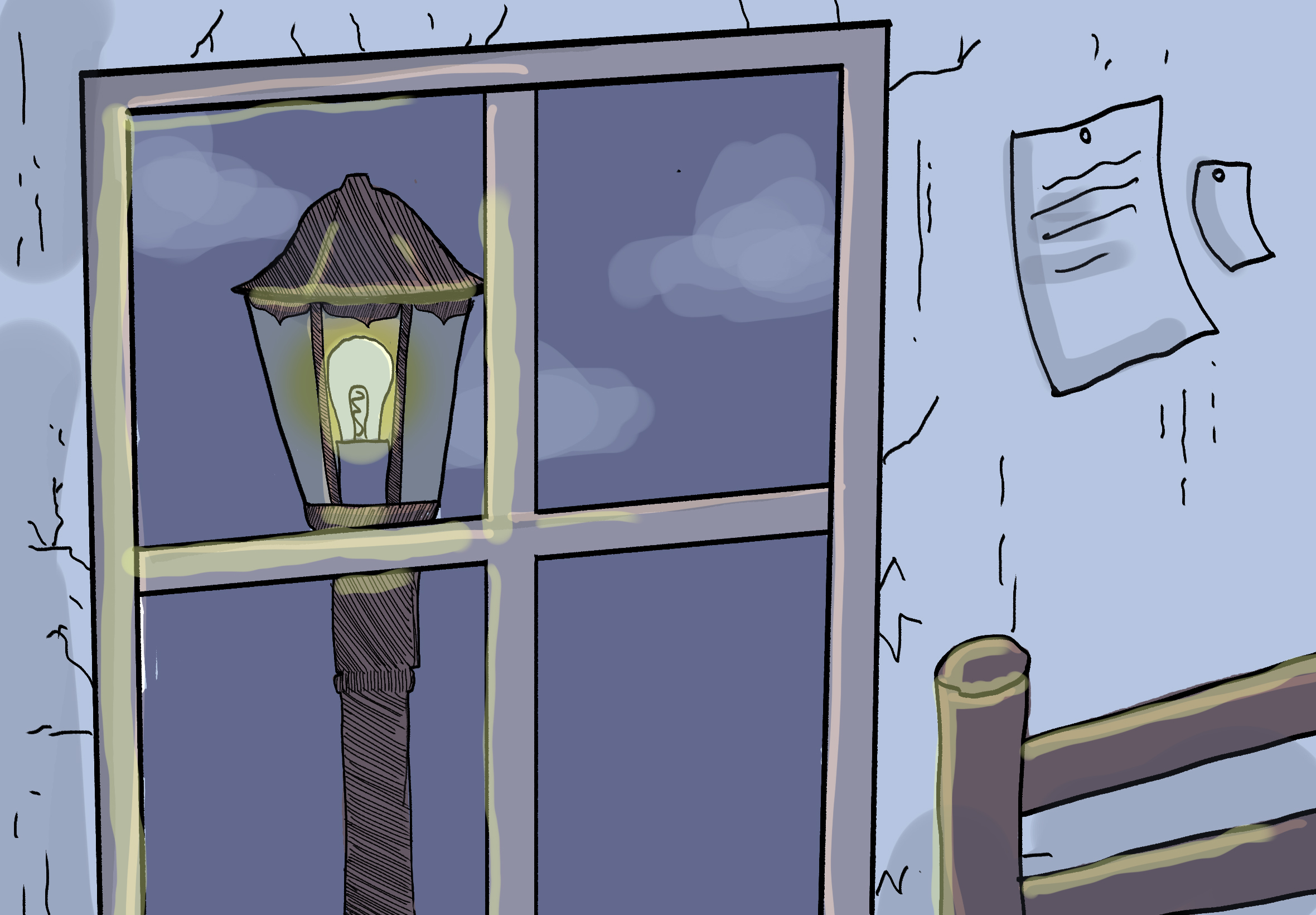
The lamp standing outside my window seemed to be glaring into my new room, in an attempt to intimidate me from sleeping. The intermittent sound of distant cars speeding their way through the nearby highway kept my ears ringing, and my mind awake. But these things, I could get used to. Eventually, my eyes would be able to adjust to the brightness of the lamp, and my ears would learn to muffle the busy roads. There was one other presence that kept me awake into the early hours of the dawn. The one truth I could not rid my mind of, the one unbearable chaos that tortured my sleep every night, was the thought of death. My apprehension of death grew so severe that my everyday life was affected by my fear of it. Flights to the US—even the car rides to the airport left me shaking in my seat, frantically looking through my window to check for threats that would bring about my untimely death. My journey to overcoming this fear and accepting death as the prerequisite to life started with a book.
As students, death is not a concept that many of us feel the need to delve deep into, as it is a reality that most of us feel is too distant to be considered. We are often overwhelmed by the several distractions that fill our daily lives; it doesn’t seem worth the while to think about something so depressing when we could be completing a task or enjoying the present. But there are facets of life that can only be discovered through a reflection of its fragility. Rather than as a daunting enemy, it is important to consider death as an ally to make our lives more fulfilling by accompanying us on our respective journeys. \
From a holistic perspective, the current, widely-held belief that we will enjoy long and healthy lives is an irregularity within the context of human history. Up until the 19th century, death was a concept far more common and immediate than what we perceive it to be in the modern age. Our ancestors likely had a completely different view of life than how we see it today; more accustomed to their own finitude. To us, students who still have our whole lives ahead of us, often deny the notion of death as a reality that is irrelevant to us, and this gives us the false pretense that today’s mistakes can be resolved in tomorrow’s opportunity. But the truth is that our time in this world is limited, and so are the number of opportunities we are given. By having faith in our tomorrow, we often put off the possibilities presented by today. We obsess ourselves with the promise of the future, and we sacrifice the lasting moments that make our lives fulfilling.
When Breath Becomes Air is an autobiography written by a young neurosurgeon faced with the impossibility of death. Diagnosed with lung cancer, I interpreted Paul Kalanithi’s memoir as not so much a cry for help and more as a warning to readers regarding the finitude of life. He describes his journey to becoming a doctor, the sacrifices he made in completing his degrees, and how his final moments with his newborn daughter helped him realize the true meaning behind life. After completing the book, I was left with one major question: How had Paul successfully come to terms with his own impending death? The answer I reached was that the neurosurgeon had never truly accepted his demise. He was afraid of leaving everything behind: his work, his wife, and his daughter. But he was also happy in the fact that he felt such immense fear of death, as such a strong emotion was an indication that his life was fulfilling and worth living. In the same way, we as Andover students have a need to recognize that what causes our fear of death is not our studies or our achievements but the parts of our lives that make it valuable, like our friends, family, and passions.
There are also a couple of other ways that we can deal with the idea of death. One such attitude that we can choose to adopt is that death makes life meaningless. But such a nihilistic point of view only acts as an excuse to avoid life’s struggles and is a temporary and impractical rejection of death. To ignore death is to demean the value of life. Not only this, but to belittle death is also to deny humanity of the only universal experience that unites us. Death is the only ubiquitous ordeal that applies to every individual without exception or discrimination. It unites us in more ways than one: in the emotion of grief, through a shared fear, and as an equalizing factor among all humans that transcends any social, cultural, or economic divides. For many, religion is their guide in their rumination on death. Faith is a framework that uses the universalizing feature of death to unite people under a common belief that relieves their anxiety and apprehension regarding death. As a result, the vast majority of religions deal with the idea of death in their own ways, whether that be through the existence of an afterlife or objectives to complete during one’s life to earn peace after death. Some turn to philosophy, relationships, or purpose to reflect upon mortality. For Andover students, driven by expectation and accomplishment, the acknowledgement of death can be in the form of a reminder to ourselves that the purpose that propels our lives forward is not praise or triumph but our ultimate happiness. Our own fear of death should not be interpreted as a detriment towards our mentality, but evidence that we are on a journey of happiness. The certainty of death assures us that it is okay for us to pursue fulfillment rather than achievement.
My lamp would not have been nearly as bright as it was if it had been lit during the day. The noise of the rushing cars was never so prominent and disruptive when the sun came up, and people began driving to work. There is only light because there is darkness. While cliché, it is one of the few universal truths that has stood the test of time. Likewise, without death, there is no life. The exclusivity and worth of life are derived from its converse, death. Thus, our goal in life should not be to avoid or ignore the concept of mortality, but rather to recognize that we should create something worth living the limited time we have. Now, when I lie in bed, I still think about my death. I imagine that it might be peaceful, on a white bed surrounded by loved ones. I worry that it might be abrupt, like a sudden car accident on my way to school. Either way, nothing has changed in the fact that I am still afraid of death. Only, I now have learned to appreciate my fear as proof that my life is one worth dying for.
“Death is not the greatest loss in life. The greatest loss is what dies inside us while we live.”
-Norman Cousins