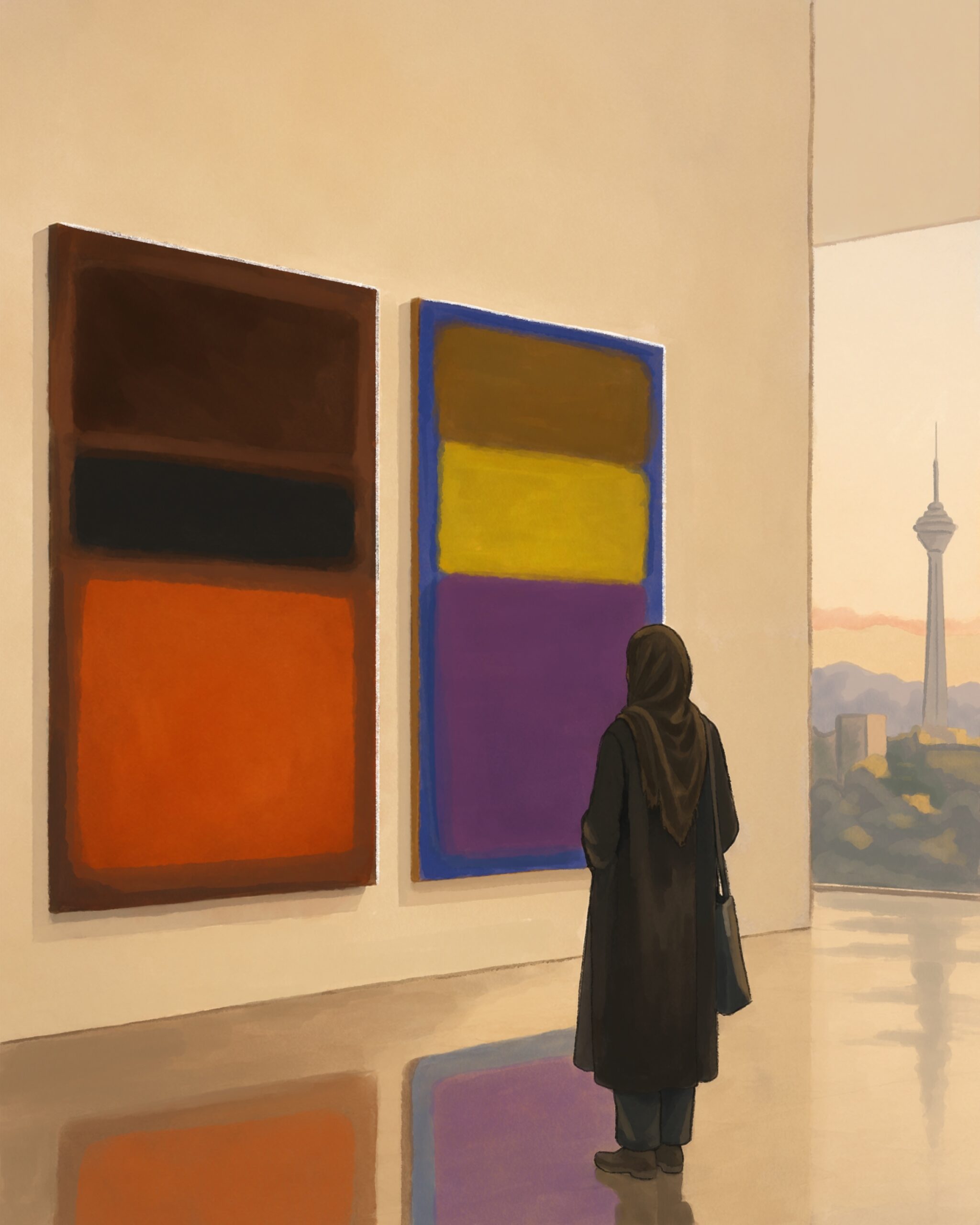
In 2015, the Tehran Museum of Contemporary Art unveiled a powerful array of Mark Rothko works in a temporary exhibition, providing a startling reminder of the cultural vibrancy that characterized Iran during the 1970s. The paintings, including “Sienna, Orange Black on Dark Brown,” and “No.2 (Yellow Center),” were brought out from an underground storage vault after decades, which indeed preserved their well-kept status, even prompting the lead curator to remark that the canvases were “in better condition than similar ones in the West.” Immediately, the exhibition attracted great fascination and respect among various international critics, curators, and artists, many of whom interpreted it as a powerful yet discreet recollection of Iran’s complex relationship with the West, as well as its own artistic fluency and national artists. In our day and age, the possibility of such an exhibition resurfacing seems wistful, as Iran’s future hangs in the precipice of further instability, and its relationship with the West appears to be in decline. Nonetheless, as art has eased tensions between such powers in the past, it may be useful to consider it a tool for future negotiations and resolutions.
Titled “Towards the Ineffable,” the exhibition was curated through a partnership between Iranian filmmaker Farah Javaherian and the then artistic director of the Fondazione Prada in Milan, Germano Celant, who recently passed away in 2020. Grounded in its cross-cultural partnership, the exhibition offered a balanced perspective on Iranian and Western art, compounded by its intentional dual focus on the likes of Rothko, Pollock, and Gauguin, alongside the famed Iranian artist Farideh Lashai. Indeed, the exhibition marked the first collaboration between Iranian and non-Iranian contributors in over three decades since the revolution, perhaps offering a beacon of hope at the intersection of cultures.
For context, the featured collection of Western art had been amassed in the 1970s by Farah Pahlavi, the shah’s wife and the artistically inclined empress of Iran. Previously, Iran lacked an adequate network of galleries and exhibition spaces for contemporary artists to exhibit their work, as existing venues were typically limited to classical Iranian art, which did not welcome abstraction and other novel techniques to the same extent. Recognizing the value of international exposure and seeking to cultivate a more open and contemporary internal platform for artists, Farah Pahlavi commissioned two revered Iranian architects to design the Tehran Museum of Contemporary Art (TMoCA). Upon its completion, artists in Iran felt newly compelled and secure to display their contemporary pieces, positively shifting the nation’s artistic atmosphere in an ample direction to impress various foreign collectors and dealers. As the influence of the TMoCA grew and an increasing number of external voices identified Iran’s mission to grow and expand its creative voice, artworks by Picasso, Van Gogh, Rothko, and Warhol were added to the museum’s permanent collection. Achieved through partnerships with lead museum curators, such as Donna Stein at MoMA, the collection flourished into a powerhouse in its own right, on par with, and even superior to, those whose works it had previously been part of.
Rothko’s presence in the exhibition reminds us of the current geopolitical situation and Iran’s tenuous relations with the West. Rothko’s works are often seen as spiritual entities in themselves, with his interplay of color and subtle luminosity powerful enough to evoke a range of emotions and ideas. Indeed, during his lifetime, Rothko often refused to classify his art as representational, remaining steadfast in his mission to paint for the sake of painting, without the burden of overt political symbolism. Given the absence of political rhetoric in his works, Rothko’s works in the collection align with art’s subtle yet revolutionary ability to captivate the masses in times of struggle. By enabling the paintings to be transported, shared, and appreciated in the first place, the 2015 exhibition served as a reminder of the value of cross-cultural exchange.
In a world ridden with emotional wars and divergent interests, art prevails as an intermediary that can inspire and sustain dialogue between separate cultures. Across the entire breadth of human existence, art has not failed in sharing some level of impact on its viewers, sellers, and buyers, either by embracing incendiary themes such as war and political dispute or by rejecting them altogether to prioritize deeply spiritual and collective reactions. Art does not shy away from being a reliable source of expression, demonstrating that at the end of the day, we are all human, and all have our individual stories, desires and wants, even if they may be temporarily sheltered in a museum basement.