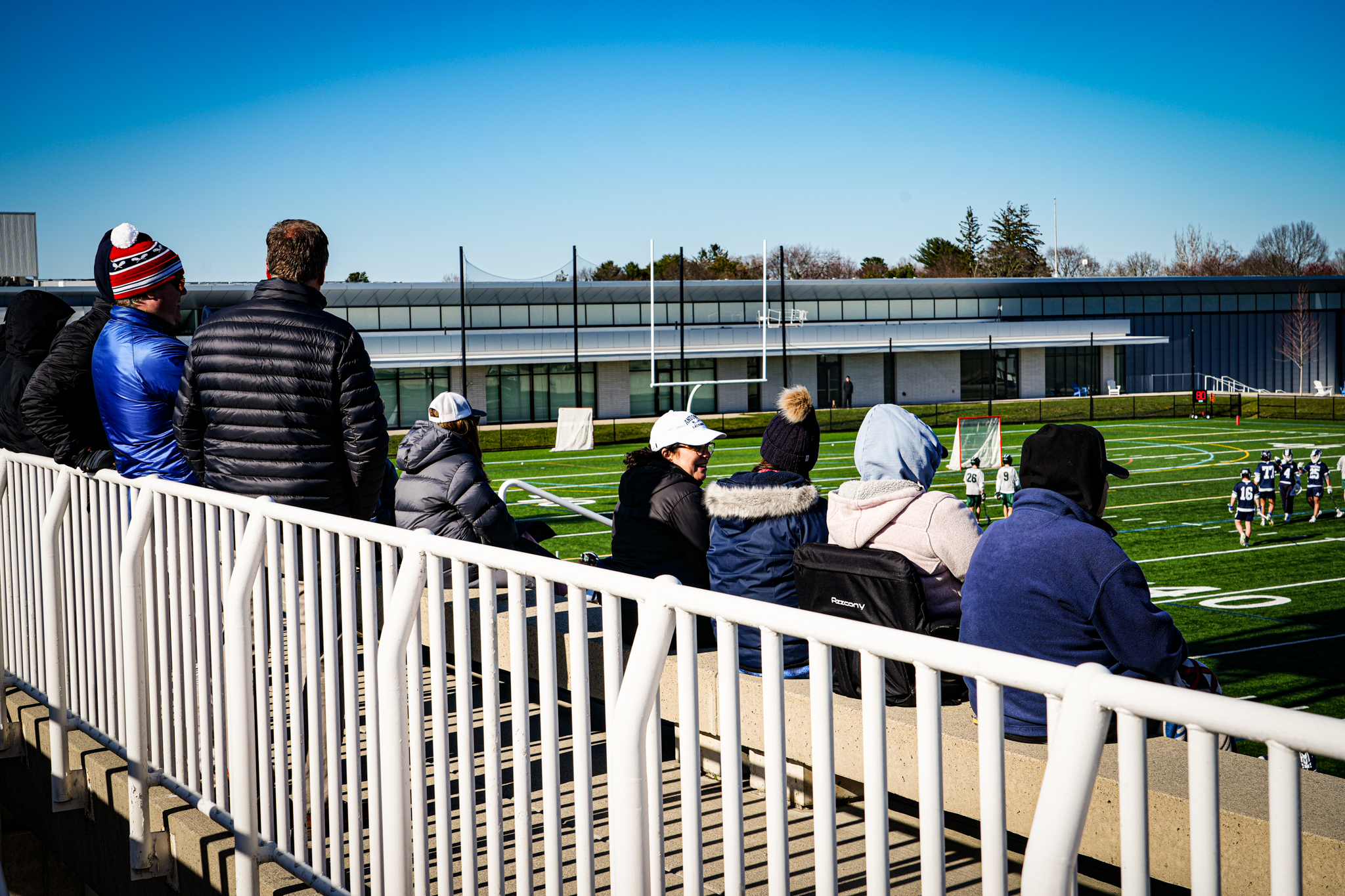
Attendance at a Boys Lacrosse game. Throughout the year, students and
faculty have noted a decline in Andover sports viewership.
Athletics is an integral part of Andover, with 67 interscholastic teams in 21 different sports. Yet, sports games at Andover have seen varying attendance this year and in the past, with some seeing much larger turnouts than others.
Daniel Matloff ’28, who plays baseball as part of the Junior Varsity (JV) team, noted a consistently lower turnout at JV games in contrast to their varsity counterparts.
“People just aren’t really interested in JV sports. A lot of people in general aren’t very interested in watching Andover sports games unless they have friends playing in them. So if someone were to just, on a random Wednesday, want to go to a game, they would prefer to go see a varsity game rather than a JV game,” said Matloff.
Sarah Bae ’26, who captains Indoor Track & Field and serves as a Blue Key Head, noted a decline in game attendance throughout her time at Andover. She explained reasons that could be attributed to this trend.
“My freshman year, especially at football games, the stadiums were packed. You couldn’t move. And now less and less people are going. I don’t know if that’s a shift in the amount of work we’re getting, or a shift in overall student happiness or interest in sports, but I feel like there’s totally been a downward trend,” said Bae.
Girls’ games are often less attended than boys’ games, a common theme that Karen Kennedy, Assistant Director of Athletics, has noted over the years. Kennedy explained how this culture has been stagnant throughout her tenure, citing an example from Andover/Exeter (A/E) in 2012.
“The Boys’ Soccer team was up 4-0 over Exeter in the first half. The Girls’ Field Hockey team was in the stadium just across the bridge going into overtime. Tied score. I tried with a few other administrators and faculty members to get the crowd to move from the boys soccer game, which was early on with a big lead over to cheer on the field hockey team. No one moved… I probably have had [ideas] and have tried to change culture, and nothing I tried to do was successful,” said Kennedy.
Kennedy explained how competitive scheduling addresses Andover’s limited capacity to host home games by scheduling certain games at similar times.
“There’s always a concern. For instance, Andover/Exeter, when we host it, our facilities and our basketball facility can’t hold all of the people that would come to the game. So, we do competitive scheduling where the Boys Hockey and the Boys Basketball [teams] are competing for fans against each other, because there’s usually not a problem of people going to the Girls Hockey game, which starts the day, or the Girls Basketball game, [which] finishes the day,” said Kennedy.
Lisa Joel, Director of Athletics, elaborated on how this strategy factors into varying attendance. She noted how students often have to make decisions about attending games within the same timeframe.
“By and large, competition days are Wednesdays and Saturdays. Those are the days everything happens. They relatively happen at the same time… So kids have to make choices about, are they going to watch Squash, are they going to watch Indoor Track, [or] are they going to watch Hockey, because it’s all happening in the relative window. They could bounce to things, but my experience is you go to the event, and then you stay at the event,” said Joel.
During A/E Weekend, there is no competitive scheduling. Joe Donnelly, Head Coach of Boys Soccer and Coach of Girls JV1 Squash, noted that these games tend to draw higher attendance.
“When we stagger the games on A/E weekend, all the games are extremely well attended because there’s only one thing to go watch at each time. A/E weekend is a great example of high attendance because everybody has the time to go see them, unless you’re playing. But even then, you get to go to the other games regularly,” said Donnelly.
Emerson Davis ’29 noted that the Spring term, in particular, has contributed to declining attendance. She explained that busier afternoons later in the year make it harder for students to attend games consistently.
“The timing of the spring term plays a major role. As the year progresses, students tend to become increasingly busy with academic and extracurricular commitments. Because of that, many people no longer have consistent free afternoons to attend games. Some sports, including crew and golf, compete off campus, which makes it difficult for them to build a consistent audience and for members of those teams to have the time to attend other games,” said Davis.
Looking forward, Bae described a possible solution to improve attendance despite the limited benefits of competitive scheduling.
“Staggering them more is obviously logistically extremely hard. But coaches can work with others if it’s a recovery day or a lighter day at practice, and the team advocates for really wanting to see the opposite gender team play,” said Bae.
Minnie Kim ’27, a captain of Girls Squash, echoed Bae’s observations. As a 2026-2027 Student Body Co-President, Kim plans to address these trends in sports game attendance in several ways, including punch cards that offer incentives for attending on-campus events.
“In some really popular [sports] like Football, Lacrosse, or Field Hockey, I don’t see a lot of student attendance. And then especially in sports that are not as popular, like Squash or Swimming or Wrestling, there’s a striking lack of student viewership… [Our punch-card initiative is] a great way to reward students for devoting that extra time to going out there, exploring different things on campus,” said Kim.
Kim continued, “Student athletes at Andover devote a lot of time and energy, and it’s really hard to manage academics and athletics. We want to recognize our student athletes in that sort of way.”