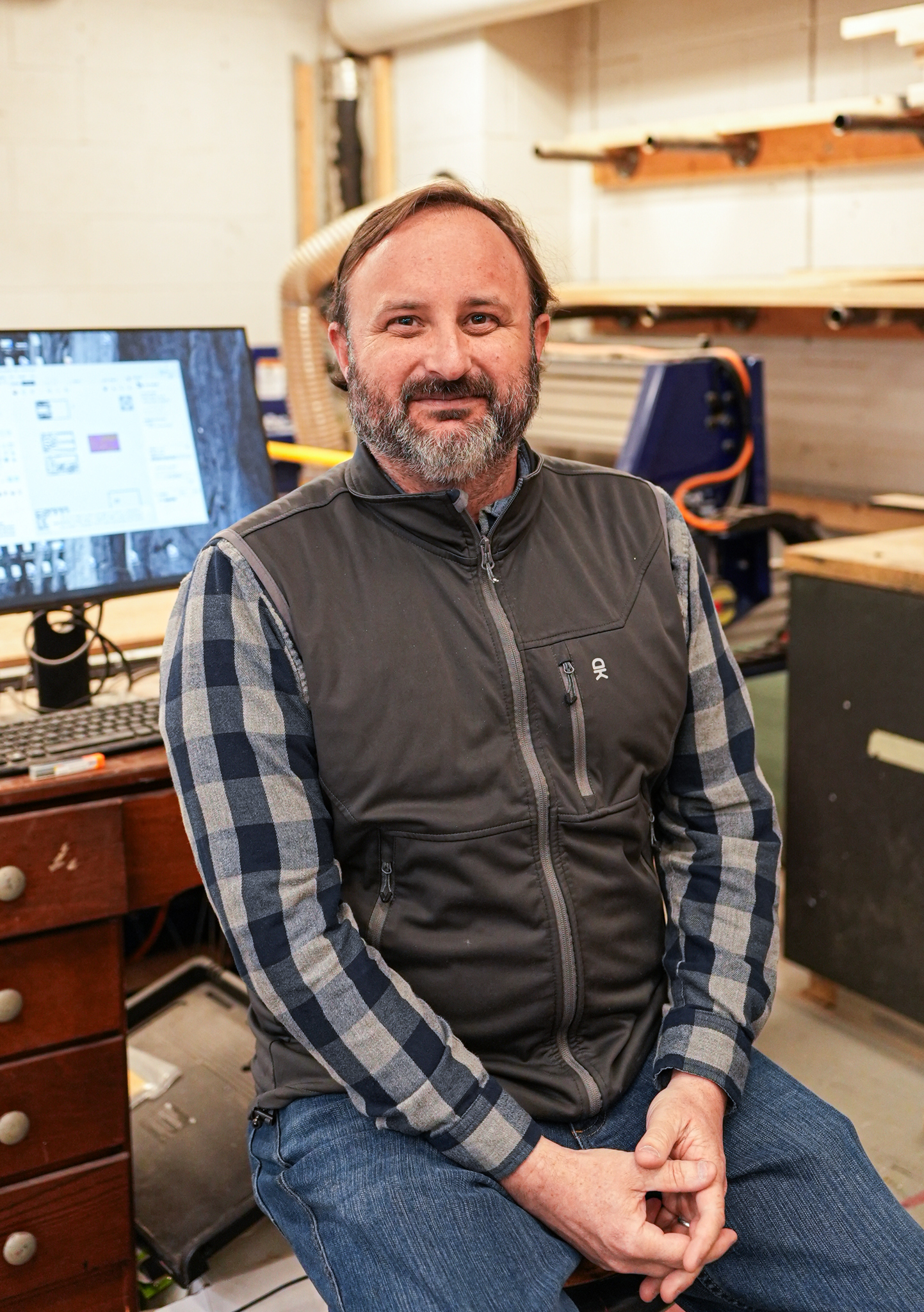
Brad Seymour ’00 (he/him) is the Technical Director of Andover’s Department of Theater and Dance and a house counselor in Stuart House. Before he arrived at Andover in 2018, Seymour obtained a Bachelor’s Degree in Theater and Dance from Colby College before attaining his Master’s Degree in Performance Production at the University of Connecticut. Additionally, he worked professionally at the Connecticut Repertory Theater and Portland Stage Company. In his free time, Seymour enjoys skiing and experiencing the outdoors.
What was your childhood like, and when did theater come into the picture?
I grew up in New Hampshire. I’m the oldest of three kids. I went to public school through 8th grade and then came [to Andover] as a 9th grader in 1996. I really found theater in high school as a pathway. I didn’t have any specific ambitions, no direct path growing up, but always had the idea that it would work itself out, and that I would find something. All kids go through phases where whatever they’re interested in, they’re trying on as a way to decide whether there is something there, or if that is interesting to them. I tried a bunch of those things and settled here on this one.
Would you say that you attending Andover yourself has helped shape your decision to pursue theater?
It provides me a certain amount of insight into where students are at. I will say that, 25, 30 years ago, the world was a very different place. The demands on students’ time, attention, and focus was very different. One of the wishes I have is that we could find a way to focus more on that ability to just try something new and explore. It would be less likely, just given everything where it is, that a student would just randomly find themselves in the theater. I could be wrong, and I’ve had some students who have done so. Being an alum, it gives me that lens, but I have to very intentionally [say] ‘this is not me, these are other students, and this is not then, this is now.’
After you graduated from Andover, you went on to attend Colby College and the University of Connecticut. What is something surprising you learned at these higher education institutions?
For Colby, I did not go in with the intention of majoring in theater performance. I went in with the intention of majoring in economics, and I did that too. For me, the surprising thing there was the realization that the theater direction was going to be the direction I was going to go. And it was in that sort of collaborative, creative field that was most interesting for me. I stuck with economics for a while, and I still am super interested in it. It’s interesting, but the realization that there was something there that was going to be the direction I was going to go was a big, important one.
You’ve worked in professional production at the Connecticut Repertory Theatre and Portland Stage Company. How would you compare professional theater to your previous experiences?
Connecticut Repertory Theatre was tied to my graduate school, so that was a resident professional company under the umbrella. Portland Stage is a professional, regional theater. Really, the biggest difference between that and the work I do in schools is what is the overall goal. In a professional theater, the overall goal, the primary goal, is to sell seats to audience members, and they’re there to see an artistic work. The sort of secondary goal from that is to do artistic work. In this setting, the primary goal is not really about audience seats. It’s not really even about art, although it’s connected. There are artistic goals there, but the primary goal is student learning, and especially for the students most directly involved, so the performers, the crew, and the production staff. We’re like, how do we set up the systems so students have this opportunity to learn from the process rather than how do we just get them to that end point? And that informs everything.
What inspired you to teach technical theater on top of practicing it?
The goals are different. If the goal is an artistic, commercial-facing performance, an artistic process that has always just sort of been less interesting to me than one where we are designing a learning process that ends in a performance. For many reasons, I think that that’s always been more interesting. Because I think that you need to be much more aware of what you’re doing. You need to really rethink how we are fitting this process, not just to students, but to our students. And one of the great things about Andover is that it’s going to look really different from term to term, just because of the cadence of our academic curriculum.
You oversee the technical side of department productions and teach courses in Set Design and Stage Craft. How do you think theater has evolved at Andover and in larger productions over the years?
At many places, theater is at best a co-curricular or purely extracurricular after-school activity. Here, it’s really woven into our program. All of our performances on the theater side are all a class, a 900-level class. All of the performances in dance are either a class or they intersect with the dance as a sport offering. Those are structural differences that have led to those paths. As students’ lives have become more complex, that structure has been really helpful for us to both tell students when we need them to be in a certain place, but also to help us define scope of what a performance project is going to be. The result of that is that we were actually able to focus on ‘what are the learning outcomes, and how do we deliver that within the sort of time envelope we have,’ rather than ‘how do we find more time and add stress to everybody.’
What is your favorite Commons meal?
A recipe hack. If it is chicken nugget day, you get a tortilla, you get some bacon and some cheese, and then you put the nuggets in, and you make a chicken bacon ranch wrap, and you put it in the panini press.
Where do you like to go and what do you like to do in your free time?
I like the [Cochran Bird] Sanctuary a lot. I’m just around the corner. It’s one of those spaces that actually feels unchanged from when I was a student, which is cool. It’s also a great place to go and disengage from the speed at which everything happens in the buildings. I spent a lot of time skiing this winter. That’s a lot of fun. The common thing I like to do is be outside. Perhaps [it is] a reaction to my job being mostly in windowless rooms.
What is one small thing that always improves your day?
In terms of theater, it’s those moments when a student very clearly has learned something that they didn’t know before and is excited by that. Sometimes they’ll struggle with something and struggle with something, and then finally the thing in their brain that was not connecting suddenly connects. And a lot of times you can actually see that happen, especially in the dance world, for example. It’s all about movement and communication, but when those sort of connections happen, it’s really rewarding to me professionally…There’s always that really cool moment when you walk outside, and it is that either the sun has gone down and you didn’t realize that it happened, or it came up. That’s more in graduate school when you’re in the studio all night, but when something’s changed outside, and you realize that you didn’t notice that happen. I’ve learned to take that as a good moment to pause, which is nice.
What is a memory you cherish that you will never forget?
I distinctly remember my daughter’s first day of school because it was that first fall back. She started kindergarten in 2020. There was a combination of my kid getting on the bus for the first time in the middle of [COVID-19] when campus was barely open. The reason I’ll never forget it is simply because it was just such an intersection of newness and discomfort. But then, it’s also helpful to realize that moments like that help you push it and realize, there were all of these variables and everything turned out fine. Your head goes through all the what ifs, and then all those what ifs are actually relatively unlikely, and you actually get to a pretty good place.