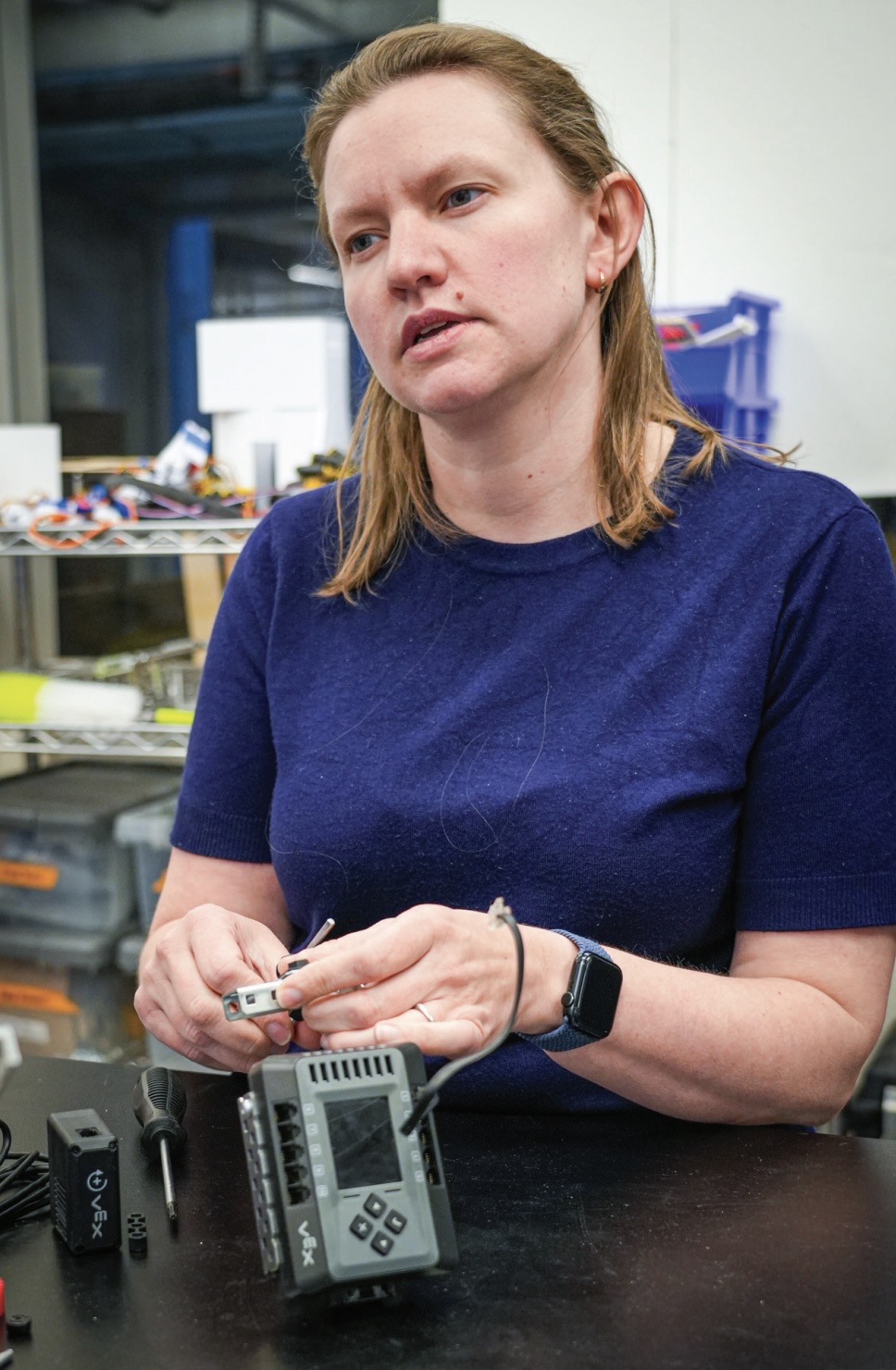
Katelin Lewellen is an instructor in Math and Computer Science and is the advisor of the Robotics Club. Lewellen has been the primary faculty member behind developing the robotics program at Andover. She has previously taught at Eastside Preparatory School and Shoreline Community College, and has worked at Microsoft and Intel. Additionally, Lewellen is a passionate runner, an avid reader, and enjoys knitting and quilting.
What has been your favorite class that you’ve taught at Andover so far?
I’ve built out the robotics [course], and I have loved having a chance to build that and teach it every term that I’ve been here so far, which has been delightful. But I have a really soft spot for the algorithms class that I’m currently teaching. I had it last winter as well. It’s really the study of how to pick the best method for doing something, which we think about in terms of computer science, but [it] applies to human life. There are all kinds of things, like the best way to organize your desk and the best way to choose a college, that you could get out of doing an algorithm class. It’s really a puzzle-solving class, and I love puzzles, so that makes me feel happy.
Where else have you taught before Andover?
I tell people I’ve taught everything from middle school to graduate school. I spent quite a long time at the University of Washington doing various types of graduate work, and taught classes to college students at the university there and graduate students. Then when I was in the process of transitioning to teaching, I taught in middle school, high school math, and high school programming, and at a community college and an independent school. So I wandered all over the place. [Andover] is the best of all of those worlds. I get the excitement of the ‘learning to be yourself’ moment of high school. But I get to teach college-level classes because [Andover] is such an awesome place to teach.
What brought you into the job of teaching?
I took a long, wandering path to teaching. Which is kind of funny, because my parents will tell you I told people I would be a math teacher when I was in middle school, but then I very quickly veered away from that. I worked at Microsoft a long time ago, and while I was there, I took on a job volunteering [to teach] in the morning to students in a [nearby] high school. And so, first period, you come in, you teach. It’s like, “bring in the industry professionals,” right? It was the best part of my day. Every single day, to be in a classroom with kids, and just seeing that moment of discovery… reminded me of the delight I had when I had first taken computer science. That was a really fun moment. I was like, well, if that’s the best part of my day, I should just go after [teaching]. Do it all the time.
As a runner, do you have a favorite race or course that you’ve run?
My first half-marathon was in the San Juan Islands, which is a collection of islands off the coast of Washington. They are gorgeous and tiny, and [the marathon] was on one of the islands where you ran along the coast. It was such delightful scenery for me to run that even when you hit that point of misery most of the way through the race, where you’re like, do we really want to be doing this? Keep running. But it’s gorgeous, and it’s like “look, there’s the ocean” and it ended on a beach. It’s like, ‘how could [it] get any better?’
What was your childhood like?
I had a very weird childhood because my parents are both in computer science. And so I grew up hanging around the Williams College campus and doing weird things in the computer labs, like hiding under desks and unplugging wires that my dad was trying to fit together. So that’s not a standard childhood. But I also had a lot of running, craz[ily], around the neighborhood, and climbing trees. I was very much a tomboy, and usually climbing trees with a book, then sitting there, and reading for a very long time. And so I [brought] a lot of books and stuff outside, and puzzles. Most of those have carried through the [many] years.
What is a hobby you particularly enjoy?
Reading, always. I’ll read anything that sits in front of me for long enough, and that’s my favorite kind of recharge activity when I’m feeling fried by work. I’ll just descend into a book for a long time. I like to knit and quilt. So I am probably the most analog tech teacher you will ever meet, because all of my hobbies have nothing to do with computers. But it’s just really nice to do things with my hand and feel, and live in the world and not just in the computer.
Do you have a favorite sports team to watch?
I really enjoy watching the Red Sox, although I listen to them more on the radio than I do watch them. I’m kind of old school in that [manner]. I like to have it on in the background. I mean, a baseball game goes on for hours. I know they’ve put in changes recently to make it go faster, which I’m not a huge fan of, but it is kind of nice to have it as a background and listen, and then stop and pay attention when something interesting happens… I love watching hockey but mostly in person. I don’t love watching hockey on TV.
What is your favorite animal, and what’s your experience with it?
I feel like I have to say dogs. I have a big dog. He’s like a 90 pound black lab that I adore. I used to volunteer at an animal shelter, and [was] a buddy for the dogs who were in there and we would matchmake. So if someone came in and was like, ‘oh, I want a dog,’ [we’d say], ‘okay, I’ll introduce you to a couple of the dogs.’ [They would] just hang out with them in basically a giant yard with a whole bunch of tennis balls and stuff. It was an awesome place.
What are you excited about in the future of education?
I get asked about AI a lot. We’re in a really interesting position where we’re in transition, and no one really knows what the transition is, and we’re all guessing on it. I keep seeing all of these doomsday articles about education and the end of the ability to grade. I see all of these different things, like, ‘oh, students are just using AI and they’re turning everything in, they’re not thinking for themselves.’ I think [AI] is actually a wonderful opportunity to rethink education and play with it in different ways. We don’t know what’s going to happen, but we can’t know unless we try it. I would love to just see more people jumping in, and just getting messy with it. Just try it and see what happens.
What is one piece of advice you would give to students who are either entering the world of STEM or are trying to pursue it in college?
STEM classes have a reputation of being really challenging and a lot of work to get through, [which can be] intimidating to people. We forget that they also tend to come with a lot of support. So I would say, don’t believe that just because it’s hard in the moment, it means you shouldn’t do it. Ask for help when you need it and find a study group. Find your people in the STEM area and stick with them.