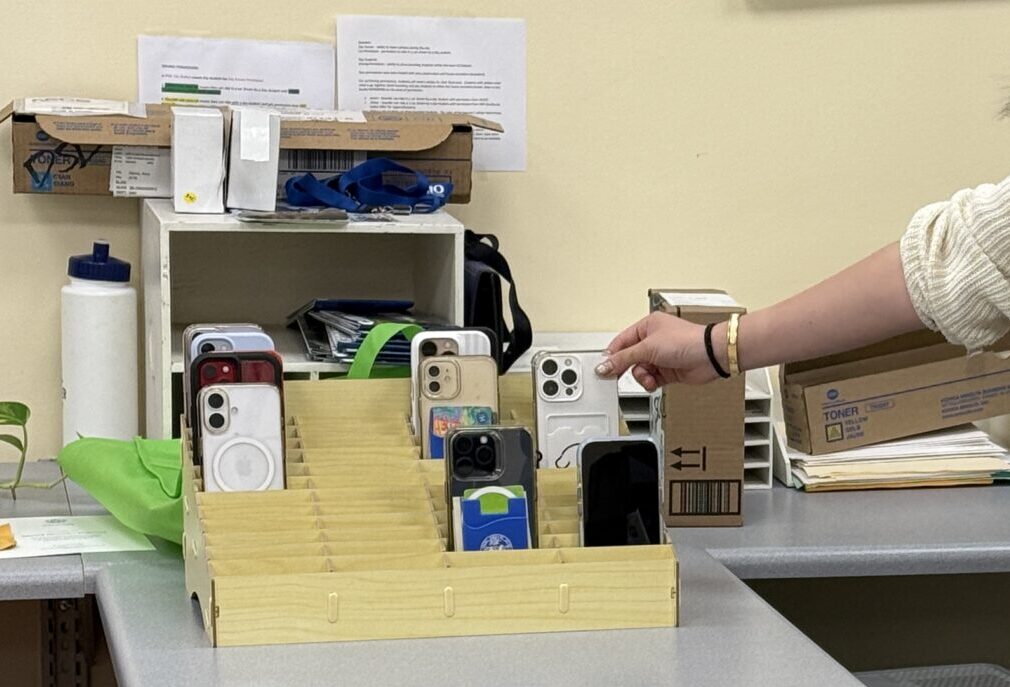
If a student’s phone is confiscated for violating the new policy, they cannot pick up their device until 3:00 p.m.
Andover’s student body received an email around two weeks before school officially started, outlining the cell phone policy for the 2025-2026 school year. The email stated that phones cannot be used during the school day unless in an approved area, must be outside of the dorm room at 11:00 p.m. for lowerclassmen boarders, and are fully prohibited in Paresky Commons food lines or the Garver Room in the Oliver Wendell Holmes Library (OWHL). The policy was created mostly by a task force consisting of students and faculty.
Susan Esty, Dean of Students and Residential Life, explained that the reasoning behind this change was mostly to increase student connection and presence. Esty commented on the reasons for fully restricting phone usage in places such as the Garver Room (Silent) and Paresky’s lines.
“In line for food, first, there’s the social connection piece. Second, what’s happened in modern life is we have paid less attention to what’s going on around us when we’re on our phones. You’re not as efficient going through the line if you’re also looking at your phone. It makes a lot of sense to talk to your neighbor. Also, when you get up to the food and get what you want, don’t be on your phone and slow down the line too,” said Esty.
Esty continued, “[Garver Room], should be silent. Cell phones had made it less silent. It is really a place of focus. You go there for a purpose. You don’t go there to just hang out. You go to [Garver Room] because you want that atmosphere. Phones should just not be part of that atmosphere and silent study.”
Colin Lee ’28 reflected on the advantages and disadvantages of the policy so far. Lee acknowledged that, while the policy’s goal of tackling excessive phone use is reasonable, its strictness makes it feel controversial.
“There’s definitely a real issue of people being on their phones too much, and it’s unhealthy socially and mentally. At the same time, this policy is partly overreaching. Parts of it seem unnecessary or unfair, and not well thought through. Perhaps if they had made it more lenient or it had more exceptions for people to use their phones, it would be healthier. But I think it does address an important issue and [works to] improve it,” said Lee.
Cristian Ramirez ’29, shared that due to not using his phone regularly regardless of the policy, his transition was relatively easy. However, he feels that communication of specific guidelines is an issue. Ramirez suggested that students should be able to use their phone between classes as long as they are not walking and texting.
“When I’m in between classes and I want to check texts to meet up with someone to study, and a teacher tells me to put my phone away, it does get annoying… Usually students stay connected and communicate with each other via their phone, especially because it’s a campus. You have friends in other dorms and friends that aren’t currently with you. If you want to communicate with them you need your phone for that,” said Ramirez.
Some students felt that the policy has been more strictly enforced in the OWHL than other areas on campus. Camille Torres Hoven, Director of the OWHL, wrote on why regulation of phones may seem more intense in the library. She emphasized that if students need their phone for any academic reason, they should talk to librarians beforehand or move to a space where phones are allowed.
“From my perspective, it probably feels more enforced in the library because students aren’t following the policy here as consistently as they do elsewhere. For example, I have not seen students in [Samuel Phillips Hall] or Gelb [Science Center] pull out their phones to scroll, text, make calls on speaker, etc. but we frequently see this happening in the library. I also think there’s been some confusion about how the OWHL fits into the policy. That said, it’s still very early days — hopefully, things will feel clearer and more consistent soon,” wrote Torres Hoven in an email to The Phillipian.
When asked about consistent enforcement, Esty noted that the administration cannot monitor every space but expects community members to follow rules. She expressed her hope that students will uphold the policy to better the community.
“We can’t be everywhere all the time, but it’s our expectation that people are upholding the phone free times and the phone free spaces. If they’re not, they’re not. The policy is really designed to be for the health and wellbeing of the community. On some level, we have to trust that people want health and wellbeing for our community,” said Esty.
Going forward, Esty explained that the school plans to monitor how the policy unfolds over the year before reassessing. She mentioned the positive effects other schools have seen after regulating cell phone use, expressing optimism that Andover might also see benefits.
“We will see how things are going through the year and at the end of the year and see where we are. We were hardly the first school to restrict cell phone usage. My understanding from not only peer schools, but from public schools, and other kinds of schools, is that they find they are happier, healthier, more productive, and just perform better all around with some limitations or regulation of cell phone use. I suspect we may find similar results for us,” said Esty.